
Opening a UK Company from Turkey in 2026: The Complete Guide to Banking, Compliance, Tax and International Growth

Executive Summary
Turkey has become home to a growing community of ambitious entrepreneurs building businesses that extend far beyond domestic borders. Technology companies, software developers, manufacturers, consultants, exporters and e-commerce brands are increasingly serving customers across Europe, the Middle East, North America and other international markets. As these businesses grow, many founders begin exploring whether establishing a UK Limited Company could support their long-term international strategy.
Online, the process often appears remarkably simple. Numerous websites suggest that incorporating a UK company takes only a short time, requires minimal documentation and provides immediate access to international banking and payment platforms. While UK company incorporation can indeed be completed efficiently, registration represents only one stage of building a successful international business.
The more significant challenge begins after incorporation.
Operating a UK company from Turkey requires careful preparation for Companies House identity verification, corporate governance, business banking, payment provider due diligence, ongoing compliance and, where relevant, cross-border tax considerations. Each of these areas has become increasingly important as regulatory expectations continue to evolve and financial institutions apply more robust risk and compliance procedures.
This guide has been written specifically for Turkish entrepreneurs who want a realistic understanding of what establishing a UK company involves in 2026. Rather than focusing solely on incorporation, it examines the broader operational journey—from preparing your business before registration through to maintaining a credible and compliant UK corporate presence after your company has been formed.
Throughout this article, you will learn:
- Why many Turkish businesses are expanding through UK corporate structures.
- The practical realities of Companies House identity verification.
- How banking and payment provider expectations have evolved.
- The importance of choosing appropriate UK corporate address services.
- Key compliance responsibilities after incorporation.
- Tax considerations that may arise when operating a UK company from Turkey.
- Common mistakes that delay business banking or create operational difficulties.
- A practical roadmap for building a credible UK business from day one.
Whether you are launching a technology startup in Istanbul, operating an e-commerce business from Izmir, running a consultancy in Ankara or exporting products to international markets, understanding these practical realities before incorporating can help you make informed decisions and build a stronger foundation for international growth.
Why More Turkish Entrepreneurs Are Looking Towards the United Kingdom
Turkey has long been recognized for its entrepreneurial spirit. Across Istanbul, Ankara, Izmir, Bursa and many other cities, founders continue to build innovative businesses that increasingly serve customers beyond the country’s borders. Digital transformation, international trade and the rapid growth of online commerce have created opportunities for Turkish companies to reach clients across Europe and the wider global marketplace.
Today, many Turkish entrepreneurs are no longer building businesses solely for their domestic market. Software companies provide development services to international clients. Digital agencies manage marketing campaigns for overseas businesses. Manufacturers export products throughout Europe and the Middle East. E-commerce brands sell through Amazon, Shopify, Etsy and their own online stores to customers in multiple countries.
As businesses become more international, founders often begin searching for a corporate structure that supports cross-border operations while presenting a professional image to global customers and commercial partners.
For many, a UK Limited Company becomes part of that conversation.
The United Kingdom continues to be recognised as one of the world’s most established business jurisdictions. Companies registered with Companies House benefit from an internationally recognized corporate framework, transparent public records and a legal system familiar to businesses, investors and financial institutions around the world.
For Turkish entrepreneurs, establishing a UK company may offer several strategic advantages depending on their business model and objectives. These can include presenting a recognized corporate identity when working with international clients, centralizing global operations, accessing UK-based professional services and building a stronger international commercial presence.
However, incorporating a UK company should not be viewed as a shortcut or a guaranteed solution to every business challenge.
A successful international business depends on far more than a certificate of incorporation. Financial institutions, payment providers, suppliers and commercial partners increasingly assess how a business operates in practice—not simply where it is registered. Factors such as business documentation, corporate governance, website quality, compliance procedures and operational transparency all contribute to the credibility of a company.
Understanding this distinction is essential.
The entrepreneurs who achieve the greatest long-term success are rarely those who focus only on registering a company as quickly as possible. Instead, they approach incorporation as the first stage of building a credible international business supported by sound compliance, professional documentation and sustainable operational practices.
That difference in mindset often determines whether a UK company becomes a valuable platform for international growth or simply another registration that proves difficult to operate effectively.
In the next section, we will examine one of the biggest misconceptions surrounding UK company formation and explain why incorporation is often the simplest part of the journey, while the real work begins immediately afterwards.

Incorporation Is Only the Beginning: Building a Business That Banks, Clients and Regulators Trust
Most articles about UK company formation stop at incorporation.
That is where the real work begins.
Many Turkish entrepreneurs spend weeks comparing company formation providers, selecting a company name and preparing their Companies House application. Once the Certificate of Incorporation arrives, they naturally assume they are ready to trade internationally.
In reality, incorporation represents only the legal creation of the company.
Building a business that banks, payment providers, regulators and international clients trust requires several additional layers of preparation.
This distinction explains why two companies incorporated on the same day can experience completely different outcomes. One begins trading smoothly, while the other faces repeated requests for additional information, delayed banking applications or payment provider reviews.
The difference is rarely the incorporation itself.
It is the business built around it.
The Seven Oak Business Readiness Framework™
The following framework illustrates how a UK Limited Company evolves from a registered entity into a credible international business.
BUSINESS READINESS FRAMEWORK™
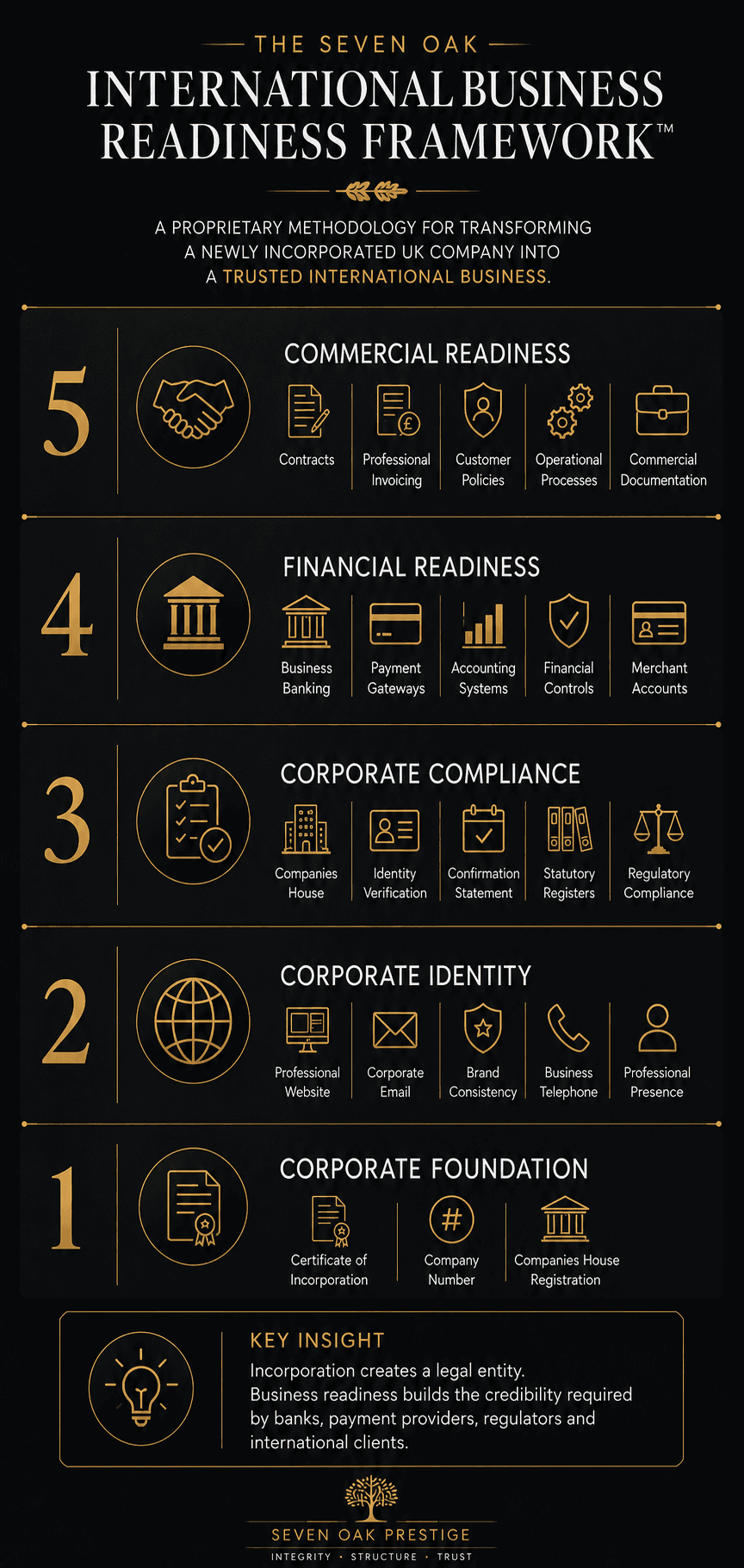
Key Insight: Incorporation creates a company. The remaining four layers transform that company into a credible international business.
Layer 1 — Legal Foundation
Every UK company begins with incorporation.
Once Companies House registers the company, it receives its Certificate of Incorporation and Company Number.
This establishes the legal existence of the business.
However, the certificate alone does not demonstrate commercial readiness.
Banks, fintech platforms and business partners expect considerably more before they establish a commercial relationship.
Layer 2 — Corporate Identity
Your company must present a consistent professional identity.
This normally includes:
- A professional business website.
- A corporate email address using your own domain.
- Clear descriptions of your business activities.
- Consistent branding across public platforms.
- Accurate contact information.
- Professional business documentation.
Today, many financial institutions perform digital due diligence before approving applications.
They often review publicly available information to determine whether the company appears genuine, transparent and commercially active.
Layer 3 — Corporate Compliance
Compliance is no longer an administrative afterthought.
It forms part of your company’s credibility.
Depending on your circumstances, this may include:
- Companies House identity verification requirements.
- Maintaining statutory registers.
- Filing Confirmation Statements.
- Meeting annual filing obligations.
- Maintaining accurate company records.
- Understanding ongoing regulatory responsibilities.
Businesses that remain organised from the beginning generally experience fewer compliance interruptions later.
Layer 4 — Financial Infrastructure
This is where many international founders encounter their first significant challenge.
Opening a business bank account or applying for payment processing is no longer based solely on incorporation documents.
Financial institutions increasingly assess the overall quality of the business.
They may review:
- Website quality.
- Commercial activity.
- Business model.
- Corporate documentation.
- Risk profile.
- Public business presence.
- Operational consistency.
A professionally structured business is often easier to onboard than one that appears incomplete or inconsistent.
Layer 5 — Commercial Readiness
Only after the previous layers are established does a company become commercially prepared for long-term international growth.
Commercial readiness includes:
- Client contracts.
- Professional invoices.
- Privacy and legal policies.
- Customer support procedures.
- Internal operational systems.
- Commercial documentation.
- Business processes that demonstrate genuine trading activity.
These elements help create confidence among clients, suppliers, financial institutions and strategic partners.
Why This Matters for Turkish Entrepreneurs
Turkish entrepreneurs increasingly operate across multiple jurisdictions, serving customers throughout Europe, North America and the Middle East.
In this environment, international credibility becomes a competitive advantage.
A UK Limited Company can support international expansion, but registration alone does not automatically establish trust.
The businesses that perform best typically invest in every layer of the Business Readiness Framework rather than focusing solely on incorporation.
Registration vs Business Readiness
Many service providers focus on helping clients obtain incorporation documents.
While incorporation is an important milestone, it represents only the legal beginning of the journey.
Before launching internationally, founders should ask themselves:
- Is our business prepared for banking due diligence?
- Does our website accurately represent our commercial activities?
- Are our corporate records complete and organised?
- Is our compliance framework established?
- Can our business demonstrate credibility to banks, payment providers and international clients?
The answers to these questions often determine whether a newly incorporated company progresses confidently or encounters avoidable delays.
Director’s Insight
Successful international entrepreneurs rarely ask:
“How quickly can I register a UK company?”
They ask:
“How can I build a UK business that banks, regulators and global clients will trust for years to come?”
That shift in mindset changes every decision made after incorporation.
Registration becomes the foundation-not the destination.
Building a Business That Banks and International Clients Can Trust
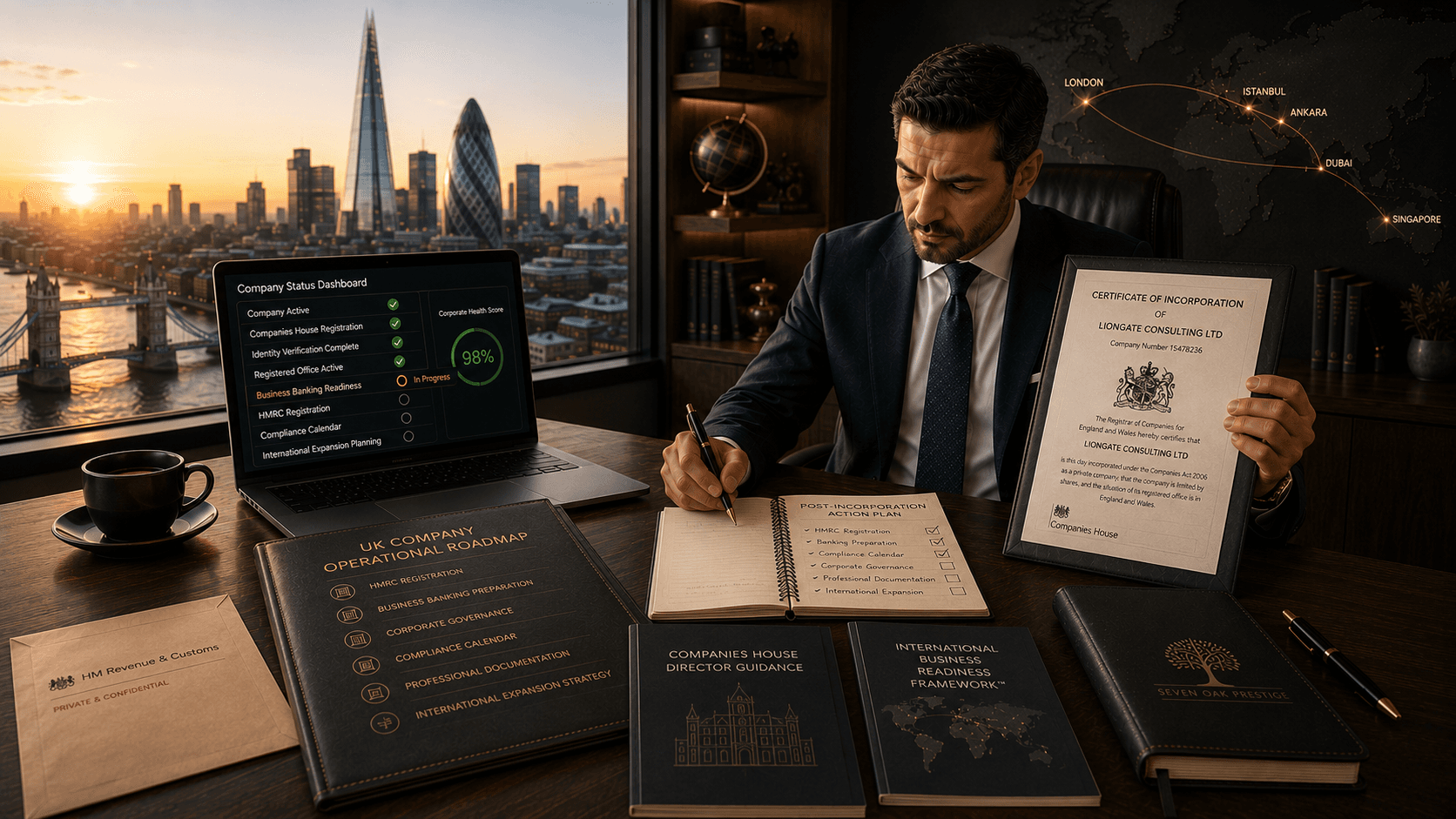
Registering a UK company is an important milestone, but incorporation alone does not establish commercial credibility. Many international entrepreneurs assume that receiving a Certificate of Incorporation means their business is immediately ready for banking, payment providers and international clients. In practice, that registration is only the beginning.
At Seven Oak Prestige, we use our International Business Readiness Framework™ to help founders understand the profound difference between simply forming a company on paper and building an entity that is functionally prepared to operate internationally.
The Core Takeaway
Incorporation creates a legal entity on paper. Business Readiness builds the cross-border credibility required by banks, payment providers, regulators and international clients to let your business operate and scale internationally.
This distinction explains why two companies incorporated on the same day can experience very different outcomes. One may establish banking relationships, payment capabilities and commercial credibility quickly, while the other encounters delays despite having identical incorporation documents.
The difference is rarely the incorporation itself. It is the quality of the preparation that surrounds it.
International Banking Is an Ongoing Relationship
Opening a corporate business account is not the end of banking compliance; it is the beginning of an ongoing relationship. Banks, Electronic Money Institutions (EMIs), and payment providers continue to monitor business activity after onboarding as part of their legal and regulatory obligations.
During routine compliance reviews, financial institutions may assess several aspects of your company’s operations to ensure they remain consistent with your declared business model, ownership structure, and expected commercial activity.
What Financial Compliance Teams May Review
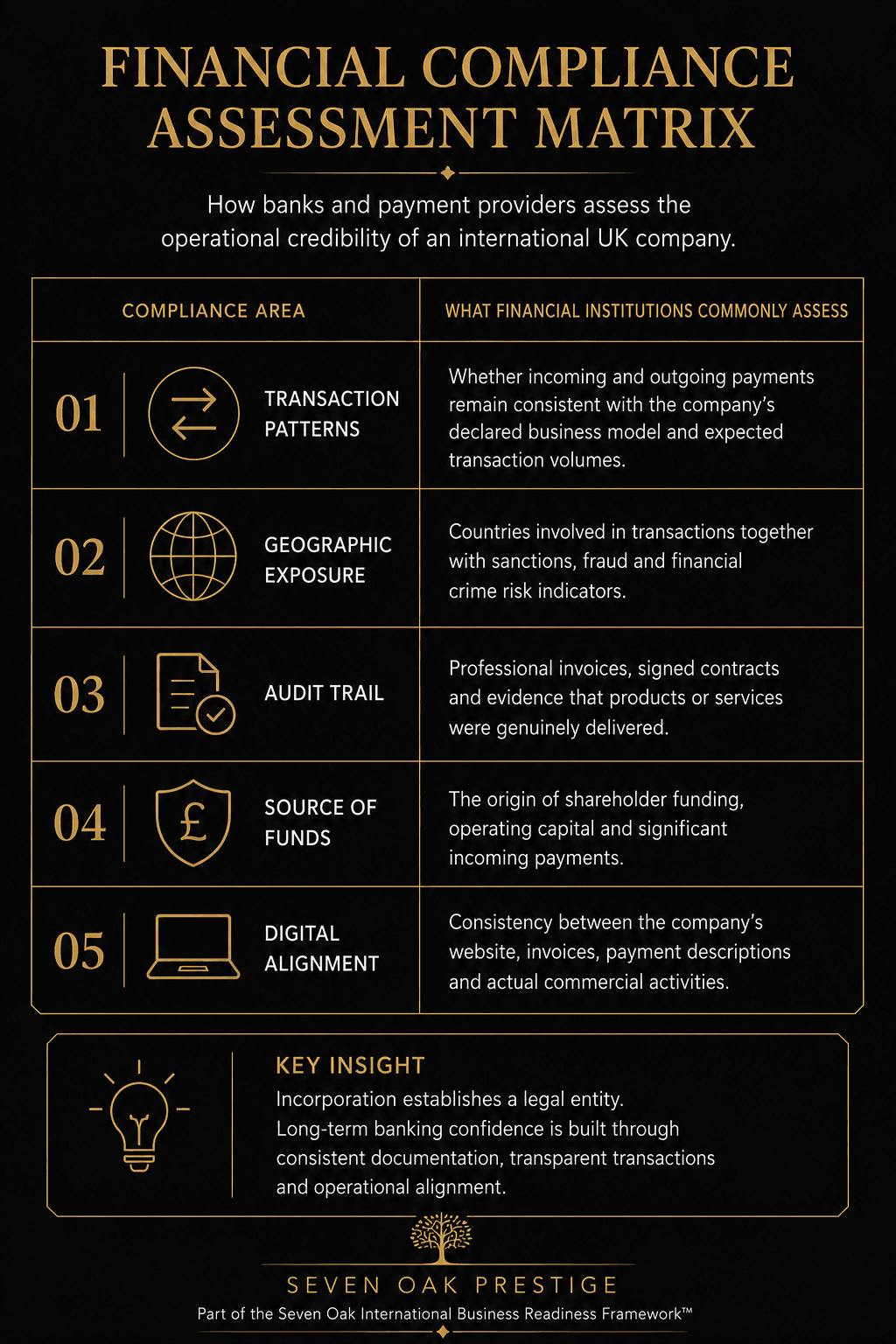
These reviews are not necessarily an indication that something is wrong. They form part of the institution’s ongoing responsibility to understand its customers and the movement of funds through its platform.
A UK company operated by a Turkish director should therefore maintain documentation that explains its activities clearly and consistently. Banking stability is built through alignment between what the company declares, what its records demonstrate, and how it operates in practice.
Protecting Corporate Credibility Through Accurate Filings
Companies House records are public. They may be reviewed not only by regulators but also by banks, payment providers, suppliers, prospective clients, and investors performing due diligence before entering into commercial relationships.
Following the implementation of the Economic Crime and Corporate Transparency Act (ECCTA), identity verification has become a key legal requirement within the UK corporate framework. Individuals who successfully complete Companies House identity verification receive an 11-character personal code, which is then used to link their verified identity to relevant director or Person with Significant Control (PSC) roles in accordance with the applicable Companies House requirements.
For Turkish directors, maintaining consistency across all corporate records is essential. This includes ensuring that the following information remains accurately aligned:
- Your valid passport and verified identity details.
- Your residential address verification documents.
- Your Companies House records.
- Your business banking and payment provider information.
- Your corporate website, invoices, and commercial documentation.
Even relatively minor inconsistencies can result in additional compliance questions or verification requests. Accuracy should therefore be viewed as an essential component of your company’s overall risk management strategy.
A Tale of Two Founders: Registration vs. Readiness
Consider two Turkish technology consultants who establish separate UK companies during the same month.
Founder A — The Registration Focus
Founder A concentrates almost entirely on completing the incorporation process as quickly as possible. The website remains unfinished, personal and company finances are occasionally mixed, invoices are prepared inconsistently, and compliance documentation is only assembled when requested by a bank or payment provider.
Founder B — The Readiness Focus
Founder B approaches incorporation as the first stage of building an international business. From the outset, the company operates with a professional website, properly drafted client contracts, organized bookkeeping, clear service descriptions, structured internal procedures, and a documented compliance calendar. Every transaction is supported by appropriate records and aligns with the company’s declared business activities.
Both founders legally own a UK Limited Company.
Only one has built a business that inspires confidence from banks, payment providers, regulators, and international clients.
The difference is not the Certificate of Incorporation.
The difference is business readiness.
Why Professional Guidance Matters
Online incorporation platforms can successfully register a UK company. However, incorporation is only one stage of establishing a business that is capable of operating internationally.
Many Turkish entrepreneurs expanding into global markets also require practical guidance with:
- Choosing an appropriate UK corporate structure.
- Completing Companies House identity verification as a non-resident.
- Establishing Registered Office and Director Service Address facilities.
- Managing official HMRC correspondence remotely.
- Building documentation that supports banking and payment provider readiness.
- Structuring cross-border operations between the United Kingdom and Turkey in a commercially organized manner.
Establishing Long-Term Trust with Seven Oak Prestige
Seven Oak Prestige supports international entrepreneurs beyond company formation. Our advisory services are designed to help founders establish businesses that are professionally structured, operationally organized, and prepared for sustainable international growth.
Our services include:
- UK Company Formation for non-resident entrepreneurs.
- Premium Registered Office and Director Service Address services.
- Guidance through the Companies House identity verification process.
- Ongoing corporate compliance and administrative advisory support.
- Banking readiness guidance based on our International Business Readiness Framework™.
Related Articles
Continue Exploring Our Knowledge Hub
If you are evaluating different jurisdictions before incorporating, you may also find these guides helpful:
- How to Start a UK Company from India
- How to Start a UK Company from Nigeria
- How to Start a UK Company from Saudi Arabia
- The Complete Guide to Companies House Identity Verification
- Why UK Business Bank Account Applications Are Rejected
Final Thoughts
Starting a UK company from Turkey can provide an excellent platform for international trade, professional services, technology businesses, e-commerce, and cross-border expansion.
However, incorporation should never be viewed as the final objective.
A successful international business is built upon a clear commercial purpose, accurate corporate records, disciplined governance, strong financial controls, and ongoing compliance with UK regulatory requirements.
Incorporation creates the legal entity. Business readiness creates the credibility required to operate and scale internationally.
About the Author
Isaac Jackson
Founder & Editorial Director, Seven Oak Prestige
Isaac Jackson specializes in helping international entrepreneurs establish and manage UK Limited Companies with confidence. Through Seven Oak Prestige, he supports founders with company formation, registered office services, business banking preparation and practical guidance on UK compliance requirements. His editorial approach focuses on transforming complex business topics into clear, practical resources that help entrepreneurs make informed decisions at every stage of their journey.
To help founders establish UK companies that are commercially credible, operationally prepared and designed for sustainable international growth.
Speak Directly with an Expansion Advisor
Skip the uncertainty and speak directly with an experienced adviser.
Whether you are planning your first UK company or strengthening an existing international structure, our team is here to help.
UK Office: +44 (0)20 4578 0726
WhatsApp (24/7): +44 7447488755
Office Hours: Monday to Friday, 09:00–18:00 (UK Time)
Website: www.sevenoakprestige.com
Email: contact@sevenoakprestige.com