
UK Company Formation from Saudi Arabia | 2026 Guide

UK Company Formation from Saudi Arabia: UK Ltd, Subsidiary, Tax & Banking Guide 2026
A person living in Saudi Arabia can generally establish, own and direct a UK private limited company without relocating to Britain.
For a straightforward founder-led company, a Saudi resident can potentially be:
100% shareholder
↓
director
↓
Person with Significant Control where the statutory conditions are met
without appointing a UK-resident shareholder simply because they live in Saudi Arabia.
But incorporation is only the first question.
The more important question is:
Should the UK company be personally owned by the Saudi founder, established as a subsidiary of an existing Saudi company, operated as a UK establishment of that company — or not created at all?
Those are materially different structures.
A founder in Riyadh operating an international SaaS company has different needs from a Jeddah e-commerce business holding inventory in Britain.
And an established Saudi company entering the UK market should not necessarily use the same structure as a solo consultant starting a new international business.
The correct sequence is therefore:
commercial objective
→ ownership
→ UK structure
→ Saudi operating position
→ tax
→ banking
→ VAT/customs
→ ongoing compliance
and only then:
incorporate the company.
If you first need the general formation framework, read our UK Company Formation for Non-Residents: Complete 2026 Guide.
UK Company from Saudi Arabia: Quick Answer
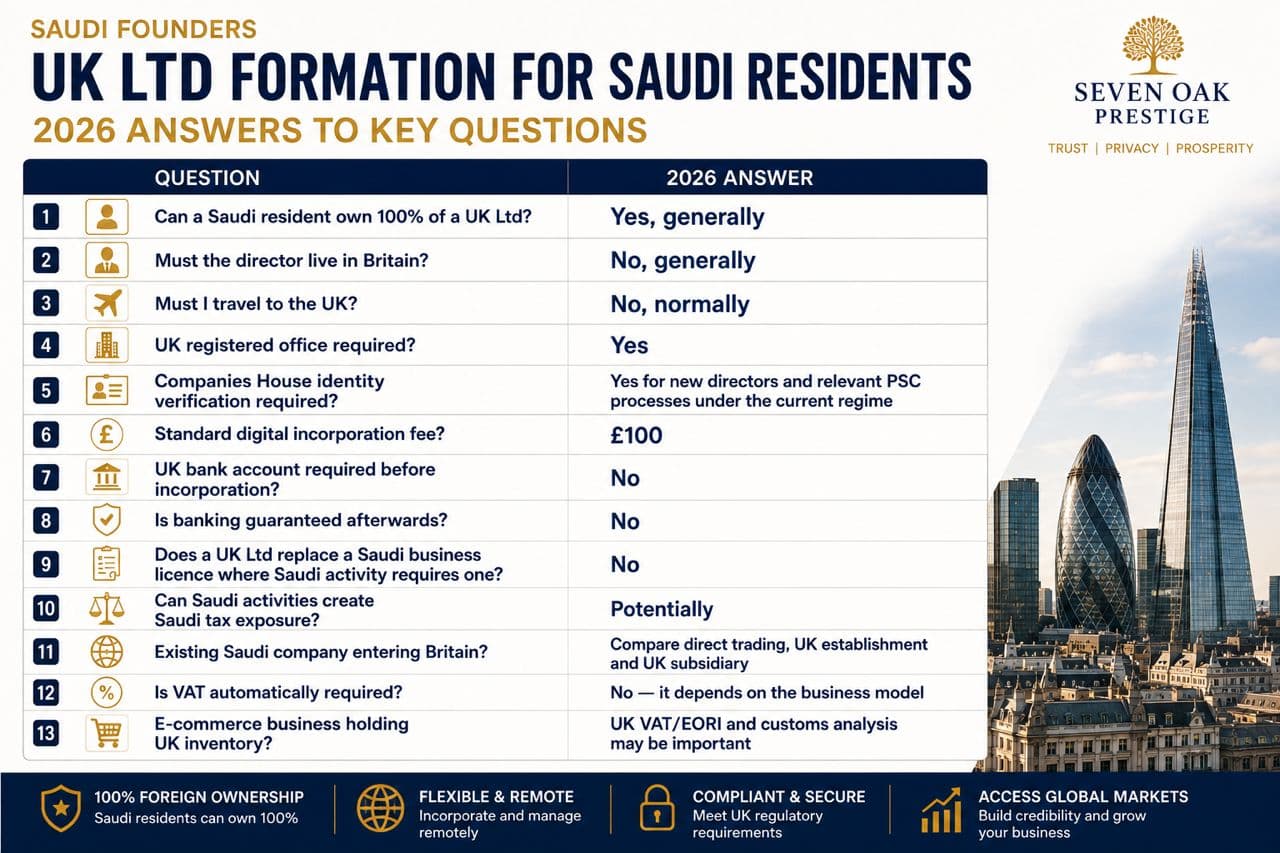
Companies House’s current fee schedule confirms a £100 standard digital incorporation fee and a £50 digital Confirmation Statement fee for the relevant annual payment period.
1. Who Should Read This Guide?
There are two main Saudi-to-UK situations.
Understanding which one applies to you is more important than completing the Companies House form.
Saudi individual founder
Examples include a Saudi-based:
- consultant;
- SaaS founder;
- software developer;
- digital agency;
- e-commerce entrepreneur;
- professional-services business;
- international trader.
The founder may be asking:
Can I personally own a UK company while continuing to live in Saudi Arabia?
Generally, yes.
But they should still consider:
- where the business is actually operated;
- which customers the UK company serves;
- banking;
- source of funds;
- tax;
- VAT;
- licences;
- annual compliance.
Existing Saudi company entering the UK
This is different.
An established Saudi company might be considering:
Saudi company
↓
UK subsidiary
or:
Saudi company
↓
UK establishment
or simply:
Saudi company → UK customers
without creating another entity.
This is a market-entry decision, not merely an incorporation decision.
That distinction is one of the most important themes of this guide.
2. How Much Does It Cost to Register a UK Company from Saudi Arabia?
This deserves an early answer because Seven Oak Prestige’s own Google Search Console data shows Saudi-based searches around:
- UK company registration fee;
- UK Ltd price;
- UK business registration cost;
- UK company formation cost.
Companies House government fee
Standard digital incorporation currently costs:
£100
Companies House increased the fee to £100 from 1 February 2026.
But:
£100 is the incorporation fee — not necessarily the complete cost of establishing an operational UK company from Saudi Arabia.
A non-resident founder may separately require:
- Registered Office;
- Director Service Address;
- Companies House identity-verification support;
- business correspondence arrangements;
- accounting;
- VAT registration;
- EORI;
- banking-readiness assistance;
- professional structuring support.
Not every company needs every service.
The correct distinction is:
legal incorporation cost
versus:
real operating setup cost.
For the detailed breakdown, read How Much Does It Cost to Register a UK Company as a Non-Resident in 2026?.
3. What Does a Saudi Founder Need to Form a UK Ltd?
For an ordinary private company limited by shares, the founder generally needs to determine:
Company name
Choose a compliant company name that is available at Companies House.
Director
At least one individual director is required for the usual private company structure.
A general UK-residence requirement does not apply merely because the director is foreign.
Shareholder
At least one shareholder.
A Saudi founder can generally be the sole shareholder.
Shares
Decide:
- number of shares;
- nominal value;
- ownership;
- rights attached to the shares.
PSC
Identify the people who meet the statutory Persons with Significant Control criteria.
Registered Office
The company needs an appropriate registered office in its UK jurisdiction.
Registered email address
Companies House also requires a registered email address.
SIC code
The SIC code should reflect the actual intended activity.
Do not select an unrelated activity simply because somebody claims it is easier for banking.
For more complex ownership, see How to Structure Shares and Directors in a UK Ltd as a Non-Resident Founder.
4. Companies House Identity Verification for Saudi Residents
Identity verification is now an important part of UK company formation.
From 18 November 2025, new directors must satisfy Companies House identity-verification requirements before incorporation or appointment. PSC verification obligations are also part of the phased statutory framework.
Verification can generally be completed:
- directly through an available Companies House/GOV.UK route; or
- through an Authorized Corporate Service Provider — ACSP.
GOV.UK confirms that a biometric passport from any country can be used through the relevant One Login identity route where the other requirements are satisfied.
After successful verification, the person receives a Companies House personal code.
That code belongs to the person.
It is not a different code for every company.
Companies House confirms that an individual who is a director of several companies generally verifies once and uses the same personal code for the relevant appointments.
For the complete process, read our Companies House Identity Verification for Non-Residents — 2026 Guide.
5. Registered Office, Service Address and Saudi Residential Address
These addresses solve different problems.
UK Registered Office
Every UK company needs an appropriate registered office within its jurisdiction of incorporation.
It is the official statutory address used for company correspondence.
It appears publicly.
Director Service Address
The director’s service address also appears on the public company record.
It can differ from the director’s private residential address.
Residential address in Saudi Arabia
A director who genuinely lives in Riyadh, Jeddah or elsewhere in Saudi Arabia should provide their actual residential information where required.
Do not replace genuine residential information with a London virtual address merely to create the impression that the founder lives in Britain.
That can later create inconsistencies with:
- Companies House;
- KYC;
- banks;
- payment providers;
- proof-of-address documents.
The company structure should reflect reality.
6. Step-by-Step: How to Form a UK Company from Saudi Arabia
Step 1 — Define the commercial reason
Start with one sentence.
For example:
“The UK company will contract with British and European customers for our software services.”
or:
“The UK company will operate as the British subsidiary of our Saudi trading business.”
If the only explanation is:
“I want Stripe.”
or:
“I heard UK companies are cheap.”
the structure deserves further thought.
Step 2 — Decide the ownership
Determine whether the shareholder should be:
Saudi individual
or:
existing Saudi company
or:
multiple genuine shareholders.
Do not postpone this decision unnecessarily until after incorporation.
Step 3 — Determine directors and PSCs
Identify the people who actually manage or control the company.
The Companies House record should reflect the real structure.
Step 4 — Arrange UK addresses
Set up:
- Registered Office;
- Director Service Address where required;
- business correspondence address if needed.
Step 5 — Complete identity verification
Relevant individuals should complete Companies House identity verification and obtain their personal codes.
Keep spelling, names, dates of birth and identity information consistent.
Step 6 — Choose the SIC code
Select codes representing the genuine business activity.
Examples might involve:
- software;
- consulting;
- e-commerce;
- trading;
- professional services;
depending on what the company actually does.
Step 7 — Prepare the filing
Companies House requires information including the proposed name, registered office, registered email and company people/ownership information.
Review everything carefully before submission.
Step 8 — Incorporate
Standard digital incorporation currently costs £100.
Do not make banking, contractual or customer promises based on an assumed incorporation time until Companies House has actually registered the company.
Step 9 — Check the public record
After incorporation verify:
- company name;
- company number;
- directors;
- PSC;
- shareholders;
- registered office;
- SIC codes.
Step 10 — Move immediately into operating readiness
The next stage can include:
- banking;
- bookkeeping;
- Corporation Tax;
- Saudi-side review;
- VAT;
- EORI;
- contracts;
- payroll;
- website disclosures;
- annual accounts;
- Confirmation Statement.
Formation is the beginning of the company lifecycle.
Read our Post-Incorporation Checklist for Non-Resident Founders.
7. Saudi Company Entering the UK: Do You Actually Need a UK Ltd?
Not necessarily.
A Saudi company selling to British customers has several possible routes.
Option 1 — Continue trading from the Saudi company
A Saudi entity may potentially serve UK customers directly without immediately creating a UK subsidiary.
This deserves consideration where there is:
- no UK office;
- no UK employees;
- no distinct British operation;
- no separate local commercial reason for another company.
However, direct trading can still create questions around:
- UK VAT;
- tax;
- contracts;
- customs;
- permanent establishments.
Option 2 — Register a UK establishment
An overseas company must register with Companies House where it sets up a place of business in the UK or usually carries on business from somewhere in Britain.
The current registration fee is:
£124
A UK establishment does not create the same legal separation as incorporating an independently registered UK subsidiary.
Option 3 — Create a UK subsidiary
Structure:
Saudi company
↓
100% or majority ownership
↓
UK Ltd
A subsidiary may be commercially attractive where the group wants:
- a distinct British operating company;
- local contracts;
- UK employees;
- separate accounts;
- local banking;
- liability separation;
- UK investment;
- acquisitions;
- long-term British operations.
The correct question is therefore not:
“Can my Saudi company open a UK company?”
It generally can.
The more important question is:
“Does the business need direct trading, a UK establishment, or a legally separate subsidiary?”
8. UK Subsidiary vs UK Establishment
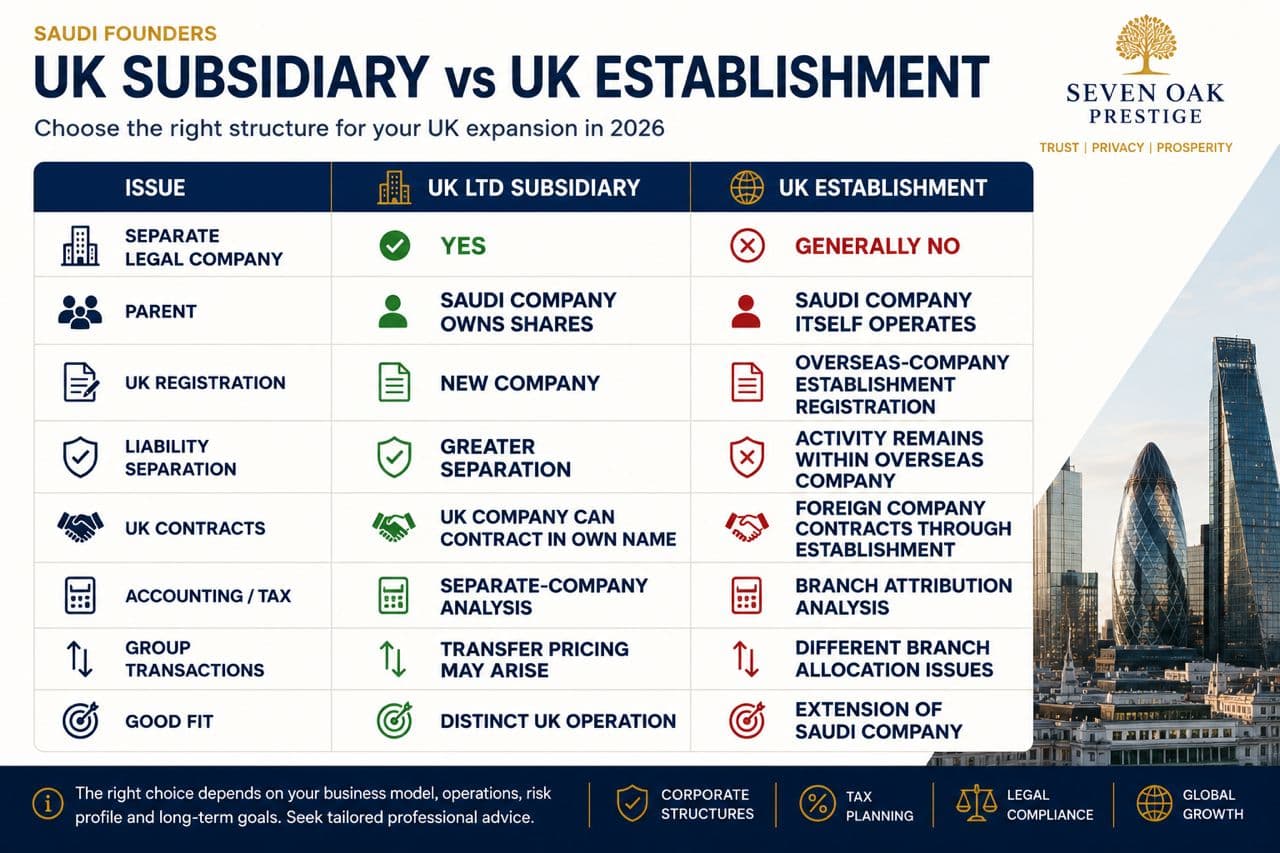
Companies House also requires overseas companies with UK establishments to satisfy specific filing and disclosure obligations.
For larger Saudi businesses, this comparison can be more important than the initial formation fee
9. UK Ltd vs Saudi LLC: They Solve Different Problems
A Saudi Limited Liability Company and a UK Ltd are both limited-liability corporate structures, but they operate under different legal systems and serve different markets.
The Saudi Ministry of Commerce describes an LLC as a separate company that can be formed by one or more individuals or entities, with the company’s liabilities separated from the personal financial liability of its owners.
The important comparison is therefore not:
“Which country has the better company?”
It is:
“Where does this business actually need an operating entity?”
For a business with:
- Saudi customers;
- Saudi workforce;
- Saudi premises;
- Saudi contracts;
- Saudi licensing;
a Saudi entity may be the natural operating vehicle.
For a genuine British operation, a UK Ltd may become commercially useful.
In some cases, the right answer is:
Saudi company
- ●
UK subsidiary
rather than choosing one jurisdiction and pretending the other does not matter.
10. Does a UK Ltd Replace Saudi Business Registration or Licensing?
No.
A UK incorporation certificate establishes a British legal company.
It does not automatically authorise regulated or locally licensable activities inside Saudi Arabia.
Saudi Arabia’s updated investment framework states that a foreign investor must register with the Ministry of Investment before carrying out relevant investment activities in the Kingdom, then obtain commercial registration and any necessary competent-authority licences.
MISA also notes that some activities can be carried out without a local partner while others may require one, depending on the activity.
Therefore:
UK company ≠ automatic Saudi operating licence.
If the company will genuinely operate inside Saudi Arabia, the Saudi requirements must be considered separately.
11. Saudi Tax Considerations: Incorporating in Britain Does Not End the Analysis
The UK company will have its own UK tax position.
But Saudi activities can also matter.
ZATCA states that Saudi Income Tax rules can apply to non-residents who:
- conduct business in Saudi Arabia through a permanent establishment; or
- derive Saudi-source income within the scope of the relevant rules.
This means a British company should not assume:
“We are incorporated in London, therefore activity in Saudi Arabia is irrelevant.”
Consider a UK company that:
- maintains a fixed Saudi operating base;
- carries out substantive local activity;
- operates through personnel in Saudi Arabia;
- earns Saudi-source income.
Those facts can require separate Saudi analysis.
Seven Oak Prestige supports the UK establishment side. Saudi tax consequences should be reviewed with appropriately qualified Saudi advisers where material.
12. UK–Saudi Arabia Double Taxation Convention
The United Kingdom and Saudi Arabia have a Double Taxation Convention.
It addresses areas including:
- residence;
- permanent establishment;
- business profits;
- dividends;
- interest;
- royalties;
- double-tax relief.
For companies potentially resident in both jurisdictions, the treaty provides a residence rule based on the place of effective management.
The treaty also defines a permanent establishment generally as a fixed place of business through which an enterprise’s business is wholly or partly carried on.
The key lesson is:
A tax treaty does not mean “no tax”.
It provides rules for allocating taxing rights and relieving qualifying double taxation.
The facts still matter.
13. UK Corporation Tax in 2026
A UK company will generally have a UK Corporation Tax position, subject to applicable residence and treaty rules.
For financial year 2026–27:
- 19% small profits rate
- 25% main rate
- Marginal Relief between the applicable £50,000 and £250,000 profit limits
subject to rules including adjustments for associated companies.
Therefore, do not rely on the common statement:
“UK companies pay 19%.”
Some do.
Others fall within the 25% main rate or Marginal Relief framework.
The shareholder’s personal/residence-country position is another question.
For the complete framework, link internally to:
UK Company Tax for Non-Residents: Corporation Tax, Dividends & International Tax (2026).
14. VAT: UK and Saudi VAT Are Separate Systems
Saudi Arabia and the UK both operate VAT systems, but they should not be treated as one combined obligation.
ZATCA’s current guidance confirms Saudi VAT’s standard rate is 15% where applicable.
In Britain, the ordinary VAT registration threshold for a UK-established taxable business is currently £90,000.
But that threshold should not be applied blindly to an overseas business.
HMRC expressly states that businesses based outside the UK supplying relevant UK goods or services can face registration requirements regardless of ordinary taxable turnover, depending on the facts.
Therefore:
Saudi VAT ≠ UK VAT
and:
UK incorporation ≠ automatic UK VAT registration
and:
below £90,000 ≠ automatically no VAT issue for every overseas structure.
The actual supply chain matters.
15. Saudi E-Commerce Founder: When Does a UK Ltd Make Sense?
Your Saudi Google Search Console data already shows interest around e-commerce company formation for non-residents.
That deserves real coverage.
A UK Ltd can potentially be used for:
- Shopify;
- Amazon UK;
- Amazon FBA;
- eBay;
- direct-to-consumer stores;
- wholesale;
- subscription commerce;
- international online retail.
But:
UK company + website ≠ complete e-commerce infrastructure.
A Saudi e-commerce founder should consider:
- supplier location;
- inventory;
- fulfilment;
- importer of record;
- UK VAT;
- EORI;
- customs;
- product compliance;
- payment providers;
- banking;
- returns;
- consumer rules.
For example:
Saudi founder + UK Ltd + inventory stored in Britain
may create a much stronger UK VAT/customs connection than:
Saudi founder + UK Ltd + digital services only.
The business model determines the obligations.
Read our UK E-Commerce Company for Non-Residents — Complete 2026 Guide.
For Amazon specifically, see our Amazon FBA UK Company for Non-Residents Guide.
16. Banking: Can a Saudi Resident Open a UK Business Account?
Potentially.
But a UK company does not create an automatic entitlement to banking.
That distinction is particularly important because Saudi-origin GSC traffic already shows interest around:
- PayPal Business;
- UK registration;
- business-account related searches.
Banks, EMIs and payment providers can independently evaluate:
- director residence;
- shareholder residence;
- UBOs;
- company activity;
- operating address;
- website;
- customers;
- suppliers;
- expected turnover;
- expected transactions;
- source of funds;
- source of wealth;
- payment geography;
- sanctions exposure;
- industry risk.
The strongest application is one where:
Companies House
- ●
website
- ●
business description
- ●
ownership
- ●
contracts
- ●
transaction expectations
all describe the same genuine business.
17. Do Not Form a UK Company Solely for Wise, Revolut, PayPal or Stripe
This is one of the biggest weaknesses in many company-formation pages.
Some Saudi-focused competitors still heavily associate incorporation with immediate access to providers such as Wise, Revolut and Stripe.
Seven Oak Prestige should take the more accurate position:
Formation makes the company legally exist. It does not force a regulated financial provider to accept it.
A UK Ltd does not guarantee:
- Wise;
- Revolut Business;
- PayPal Business;
- Stripe;
- Airwallex;
- traditional UK banking;
- marketplace onboarding.
Provider criteria can change.
And the founder’s residence and business model can matter as much as the country of incorporation.
Do not design the company around one provider’s current onboarding page.
Design the company around the business.
18. UK Ltd for Saudi SaaS and Technology Founders
For SaaS, software and technology founders, a UK company may make commercial sense where:
- British customers matter;
- international contracting through Britain is useful;
- UK investors are expected;
- the company will own relevant IP;
- a genuine UK team may be developed;
- the business wants a distinct UK operating vehicle.
Questions to settle include:
- Who owns the software/IP?
- Where do developers work?
- Which company contracts with customers?
- Where is strategic management?
- How will the company be funded?
- Will there be a Saudi company and UK subsidiary?
- Are intercompany services expected?
The correct structure becomes increasingly important as the company grows.
19. UK Ltd for Saudi Consultants and Professional-Service Businesses
A Saudi-based consultant can generally establish a UK company.
But the decision should still reflect:
- customer geography;
- physical work location;
- Saudi licensing requirements;
- tax;
- banking;
- contract structure.
A UK incorporation address should not be used to create the appearance that services are performed in Britain when the actual business operates elsewhere.
Similarly, the UK Ltd does not eliminate local professional licensing where Saudi law requires it.
20. International Trading and Saudi–UK Commerce
A Saudi trading business may consider a UK company where it has genuine UK commercial activity.
Relevant questions include:
- who purchases the goods;
- who owns inventory;
- where goods are stored;
- who imports into Britain;
- who signs customer contracts;
- where profits arise;
- whether customs/EORI obligations exist;
- whether the Saudi company and UK entity trade with each other.
Where a Saudi parent and UK subsidiary transact, the relationship should have a genuine commercial basis.
Intercompany:
- purchases;
- services;
- loans;
- management fees;
- IP licences;
can raise tax and transfer-pricing questions.
21. Saudi Parent → UK Subsidiary: Treat the Two Companies Separately
Once this structure exists:
Saudi company
↓
UK Ltd
you have two companies.
Do not treat them as one bank account.
Potential intercompany arrangements might involve:
- management services;
- technology;
- marketing;
- intellectual property;
- purchasing;
- staff;
- financing;
- loans;
- commissions.
The arrangements should be documented and commercially supportable.
A corporate group is more sophisticated than a founder-owned standalone Ltd — and should be managed accordingly.
22. What Happens After Incorporation?
A Saudi-based director still needs to maintain the UK company.
Depending on the circumstances, obligations can include:
Companies House
- annual accounts;
- Confirmation Statement;
- changes to company information;
- identity-verification compliance.
HMRC
- Corporation Tax;
- Company Tax Return;
- VAT where applicable;
- PAYE where relevant.
Internally
- bookkeeping;
- company records;
- contracts;
- shareholder records;
- supporting documents.
The company should also maintain consistency across:
- invoices;
- website;
- banking;
- contracts;
- Companies House.
For the complete operational checklist, read What Happens After You Register a UK Company as a Non-Resident?.
23. When a UK Company May NOT Be the Right Choice for a Saudi Founder
This is just as important as explaining how to form one.
Your business is entirely Saudi-based
If you have:
- Saudi customers;
- Saudi premises;
- Saudi employees;
- Saudi contracts;
- Saudi management;
- no genuine British commercial requirement;
adding a UK company may create complexity without solving a meaningful problem.
Your only reason is banking
Do not create a company simply because somebody promises an account.
Your only reason is Stripe or PayPal
Provider approval remains separate.
Your only reason is “international credibility”
Credibility can support a genuine corporate strategy.
It is not, by itself, a tax or operational strategy.
Your activity requires Saudi authorisation
A British incorporation certificate does not replace Saudi licensing or investment requirements.
You already have a Saudi company and have not compared direct trading vs subsidiary
A second company creates another accounting and compliance layer.
First determine whether it performs a genuine function.
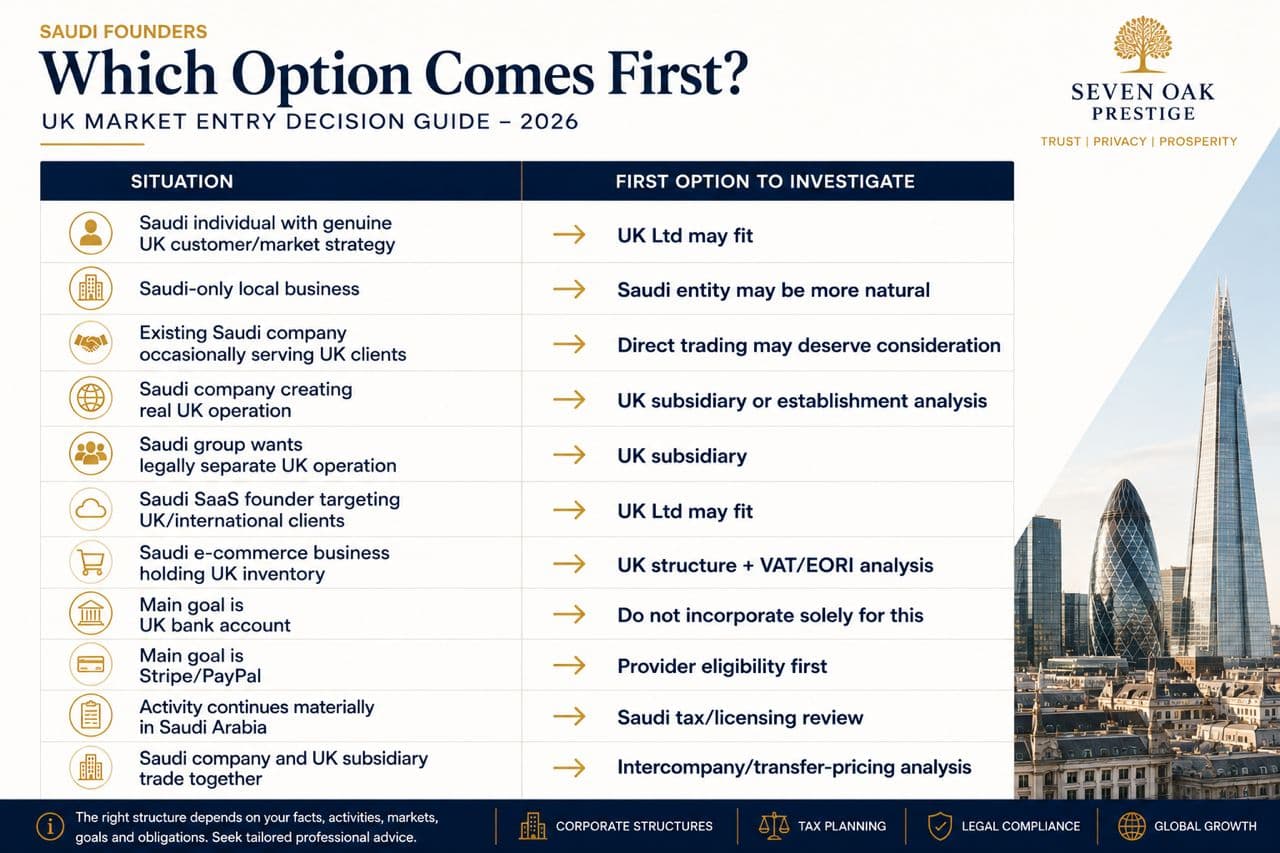
24. Saudi Arabia → UK Decision Matrix
25. Saudi Founder Pre-Incorporation Checklist
Before incorporating, answer these questions.
Commercial rationale
Why does the UK company exist?
Ownership
Who should own it?
- founder personally?
- Saudi company?
- several founders?
Management
Where will strategic decisions actually be made?
Customers
Where are customers?
- Saudi Arabia?
- UK?
- GCC?
- Europe?
- global?
Operations
Where are:
- staff;
- contractors;
- inventory;
- offices;
- fulfilment?
Saudi position
Does the activity require:
- local registration;
- investment registration;
- professional licensing;
- Saudi VAT/tax consideration?
UK tax
Have you considered:
- Corporation Tax;
- VAT;
- payroll;
- customs?
Banking
Which providers support:
- actual founder residence;
- actual business activity;
- actual ownership structure?
Group structure
If a Saudi company already exists:
- direct trading?
- establishment?
- subsidiary?
Ongoing compliance
Who handles:
- accounts;
- Corporation Tax;
- Companies House;
- Saudi requirements?
If those answers are not yet clear, formation may be premature.
Frequently Asked Questions
Can a Saudi resident form a UK company?
Generally, yes.
A Saudi resident can generally establish and own a UK private limited company without relocating to Britain.
Can a Saudi citizen own 100% of a UK Ltd?
Generally, yes.
There is no general requirement for a British co-shareholder simply because the owner lives in Saudi Arabia.
Do I need a UK-resident director?
Generally, no for an ordinary UK private limited company.
Do I need to travel to Britain?
Normally, no.
Standard company formation can generally be handled remotely.
How much does UK company formation cost?
Companies House currently charges £100 for standard digital incorporation.
Professional services, UK addresses, accounting, VAT/EORI and other operational services are separate where required.
Do Saudi directors need Companies House identity verification?
New directors need to satisfy the current Companies House identity-verification requirements, which became mandatory from 18 November 2025.
Can I verify with a Saudi passport?
GOV.UK’s identity-verification guidance accepts a biometric passport from any country as one of the supported photo-ID types for the relevant One Login route.
Do I need a UK Registered Office?
Yes.
A UK company must have an appropriate registered office within its jurisdiction of incorporation.
Does a UK company give me a UK visa?
No.
Company ownership and immigration permission are separate.
For the distinction, read Do You Need a UK Visa to Own or Run a UK Limited Company as a Non-Resident?.
Can my Saudi company own the UK company?
Yes, a corporate shareholder can potentially own a UK Ltd.
The resulting Saudi-parent/UK-subsidiary structure deserves proper accounting and tax analysis.
Does my Saudi company need a UK subsidiary to sell to Britain?
Not automatically.
Depending on the facts, the company may be able to trade directly or may need to consider a UK establishment or subsidiary.
What is a UK establishment?
It is the registration of an overseas company carrying on business through a UK place of business.
Companies House currently charges £124 for registration.
Will my UK Ltd be taxed in Saudi Arabia?
Potentially, depending on its Saudi activities, income and presence.
ZATCA rules can apply to non-residents conducting business through a Saudi permanent establishment or deriving relevant Saudi-source income.
Is there a UK–Saudi tax treaty?
Yes.
The UK–Saudi Double Taxation Convention addresses residence, permanent establishments, business profits and other cross-border tax issues.
What is Saudi VAT?
Saudi Arabia’s standard VAT rate is currently 15% where applicable.
Saudi VAT and UK VAT are separate systems.
Is UK VAT automatically required?
No.
The answer depends on the company’s supplies and establishment.
Be careful with overseas businesses because UK VAT rules can apply differently from the ordinary £90,000 threshold.
Can a Saudi founder obtain a UK business account?
Potentially.
But provider approval is independent of company incorporation and depends on the applicant, business and risk profile.
Does a UK Ltd guarantee Wise, Revolut, Stripe or PayPal?
No.
Each provider conducts its own eligibility, KYC and risk assessment.
Is a UK Ltd good for Saudi e-commerce founders?
Potentially where there is a genuine UK commercial or fulfilment rationale.
But VAT, EORI, inventory, customs, marketplace rules and banking must also be considered.
The Seven Oak Prestige Saudi–UK Structure Test
Before treating a Saudi-to-UK company as operationally ready, we believe seven areas should align.
1. Commercial rationale
Why does the British company exist?
2. Ownership
Should it be owned by the Saudi founder or an existing Saudi company?
3. UK company compliance
Are directors, shareholders, PSCs, addresses and identity verification correct?
4. Saudi operating position
Does the activity create Saudi licensing, tax or permanent-establishment considerations?
5. Tax and VAT
Have UK Corporation Tax, Saudi rules, VAT and treaty considerations been reviewed where relevant?
6. Banking readiness
Does the company have a coherent ownership, activity, website and transaction profile?
7. Ongoing compliance
Is there a process for Companies House, HMRC, accounting and any Saudi obligations?
That is the difference between:
registering a UK company from Saudi Arabia
and:
building a Saudi–UK business structure that can actually operate.
How Seven Oak Prestige Helps Saudi Founders and Businesses
Seven Oak Prestige supports international entrepreneurs and overseas companies with the UK side of company establishment and operational readiness.
Support can include:
- UK Limited Company formation;
- Saudi-parent / UK-subsidiary setup;
- shareholder and director structuring;
- PSC preparation;
- Companies House identity-verification support;
- Registered Office;
- Director Service Address;
- Virtual Business Address;
- VAT registration;
- EORI registration;
- banking-readiness preparation;
- post-incorporation compliance planning.
Our approach is not:
“Every Saudi entrepreneur should form a UK company.”
That would be poor structuring.
The objective is to determine whether the UK entity has a real commercial role and, where it does, establish the UK side coherently.
Start My UK Company from Saudi Arabia
For Saudi-based founders who have already determined that a UK Ltd fits their business model and want assistance with the UK formation and establishment process.
Start My UK Company
Review My Saudi–UK Setup
For founders or existing Saudi businesses deciding between:
- personally owned UK Ltd;
- Saudi company → UK subsidiary;
- UK establishment;
- direct Saudi-company trading;
- another UK market-entry structure.
Review My Saudi–UK Setup
Final Takeaway
A Saudi resident can generally establish and own a UK Limited Company without relocating to Britain.
An existing Saudi company can also potentially create a British subsidiary or establish a UK place of business.
But company registration should not be the first decision.
The stronger sequence is:
Saudi founder or Saudi company
↓
commercial objective
↓
UK market requirement
↓
direct Saudi trading vs UK entity
↓
personal UK Ltd vs subsidiary vs establishment
↓
ownership and management
↓
Companies House identity verification
↓
UK tax + Saudi considerations
↓
VAT / customs
↓
banking
↓
ongoing compliance
↓
Only then: establish the company.
The easiest entity to register is not always the best entity to operate.
For a Saudi founder or business, the strongest UK structure is one that has a real British commercial purpose and remains coherent on both sides of the relationship.
RELATED GUIDES
Use these natural internal links throughout the CMS rather than dumping them all into one paragraph.
General formation
UK Company Formation for Non-Residents: Complete 2026 Guide
Formation cost
How Much Does It Cost to Register a UK Company as a Non-Resident?
Identity verification
Companies House Identity Verification for Non-Residents
Ownership
How to Structure Shares and Directors in a UK Ltd
Post-incorporation
What Happens After You Register a UK Company?
E-commerce
UK E-Commerce Company for Non-Residents
Amazon
Amazon FBA UK Company for Non-Residents
Immigration
Do You Need a UK Visa to Own or Run a UK Company?
UK Company Tax for Non-Residents
Business Banking & Fintech Guide for International Entrepreneurs
Primary Sources Reviewed
Companies House — fees
Standard digital incorporation is currently £100; digital Confirmation Statement £50.
Companies House — identity verification
Mandatory identity verification began from 18 November 2025 for new directors, with PSC requirements phased into the framework.
Companies House — overseas company / UK establishment
Overseas companies establishing a UK place of business can require registration; current fee £124.
UK–Saudi Arabia Double Taxation Convention
Covers residence, place of effective management, permanent establishment and other cross-border tax matters.
ZATCA — Saudi Income Tax
Saudi rules can apply to non-residents carrying on business through a Saudi permanent establishment or deriving relevant Saudi-source income.
ZATCA — Saudi VAT
The standard Saudi VAT rate is currently 15% where applicable.
Saudi Ministry of Investment — investment framework
Foreign investors can need MISA registration before carrying out investment activity in Saudi Arabia, followed by relevant commercial registration/licensing.
Saudi Ministry of Commerce — LLC framework
Saudi LLCs are separate limited-liability entities and can be formed by individuals or legal entities under the applicable framework.
HMRC — UK Corporation Tax
2026–27 ordinary rates remain 19% small profits and 25% main rate, with Marginal Relief between the statutory thresholds.
HMRC — VAT
The ordinary UK-established threshold is £90,000, but overseas/non-established businesses can be subject to different registration rules.
About the Author
Isaac Jackson
Founder & Managing Director — Seven Oak Prestige Ltd
Isaac Jackson has 3+ years of hands-on experience supporting international entrepreneurs with UK company formation, Companies House compliance and cross-border business-establishment matters.
Seven Oak Prestige has supported close to 100 UK company formation and establishment cases, including overseas founders requiring assistance with ownership structure, Companies House identity verification, UK address infrastructure, banking readiness and post-incorporation planning.
For Saudi Arabia-focused content, the editorial emphasis is on distinguishing simple UK incorporation from a commercially coherent Saudi–UK structure, including individual ownership, Saudi-parent subsidiaries, banking readiness and post-incorporation obligations.
Last reviewed: August 2026
Editorial Methodology
This guide is maintained using four layers of review.
Primary regulatory evidence
Current material from:
- Companies House;
- HMRC/GOV.UK;
- ZATCA;
- Saudi Ministry of Investment;
- Saudi Ministry of Commerce;
- UK–Saudi Arabia Double Taxation Convention.
Practical international-founder experience
The article incorporates recurring issues seen in international formation work, including:
- identity verification;
- ownership;
- registered addresses;
- banking;
- source of funds;
- activity consistency;
- VAT/EORI;
- post-incorporation compliance.
Editorial Disclaimer
This article provides general UK company-formation and Saudi–UK business-establishment information.
It is not personalized:
- UK legal advice;
- Saudi legal advice;
- UK or Saudi tax advice;
- accounting advice;
- investment advice;
- immigration advice;
- banking approval advice.
Tax residence, permanent-establishment treatment, Saudi licensing, ZATCA obligations, VAT, transfer pricing and treaty outcomes depend on the actual circumstances.
Seven Oak Prestige supports the UK company-establishment and operational-readiness side of international structures.
Where Saudi tax, legal, licensing or investment matters are material, appropriately qualified Saudi professionals should be consulted before implementation.