
Can a New UK Company Get a Sponsor Licence? 2026 Guide

Can a New UK Company Get a Sponsor Licence? A Guide for Non-Resident Founders
By Isaac Jackson, Founder & Managing Director — Seven Oak Prestige Ltd
Last reviewed: 28 September 2026
A newly established UK company is not automatically prevented from applying for a sponsor licence simply because it is new.
But registering a company at Companies House does not make it sponsor-ready.
The Home Office looks beyond incorporation. It considers whether the applicant is a genuine organisation operating or trading lawfully in the UK, whether it can meet the requirements of the relevant sponsorship route, and whether it can comply with its responsibilities as a sponsor.
For international founders, four points are especially important:
Company formation and immigration are separate. Owning a UK company does not give its founder permission to live or work in the UK.
Businesses operating or trading in the UK for less than 18 months face a specific banking-evidence requirement under the Home Office supporting-document rules.
Sponsor key personnel have their own requirements. An overseas founder cannot assume that a formation agent, virtual-office provider or unrelated UK contact can simply fill those roles.
And most importantly:
A UK company should not be created on the assumption that incorporation will provide its overseas founder with a route to a UK visa.
If you are still at the incorporation stage, start with our UK Company Formation for Non-Residents guide.
If your main question is whether you need a visa simply to own or direct the company while living abroad, read Do You Need a UK Visa to Own or Run a UK Limited Company as a Non-Resident? . That is a separate question from sponsor licensing. The existing Seven Oak guide makes the same distinction between company ownership and permission to work physically in Britain.
Quick Answer: Can a New UK Company Get a Sponsor Licence?
Potentially, yes.
There is no general rule requiring an ordinary UK company to have existed for a fixed number of years before it can apply for a sponsor licence.
But that does not mean every newly incorporated company will qualify.
Is Companies House registration enough?
No.
Incorporation establishes the company as a legal entity. It does not by itself demonstrate genuine UK operations or satisfy the Home Office sponsor requirements.
Must a company wait 18 months before applying?
No.
The 18-month rule is not a waiting period.
Instead, a business that has been operating or trading in the UK for less than 18 months is treated as a “start up” for the relevant Home Office documentary requirements and generally needs to provide specific UK banking evidence.
Can the overseas owner form a company and use it to sponsor themselves?
This should not be assumed.
The Home Office guidance specifically considers situations where an overseas person establishes a UK company and then seeks to use that company to facilitate their own entry or residence in the UK.
Is a UK Registered Office enough to demonstrate UK operations?
No.
A Registered Office fulfils a Companies House address requirement. It does not automatically demonstrate genuine trading activity, employees, operating premises or sponsor readiness.
Does a sponsor licence guarantee a visa?
No.
A sponsor licence relates to the organisation. The worker’s immigration application remains a separate process.
The principle to remember is:
UK company formation ≠ sponsor licence approval ≠ visa approval.
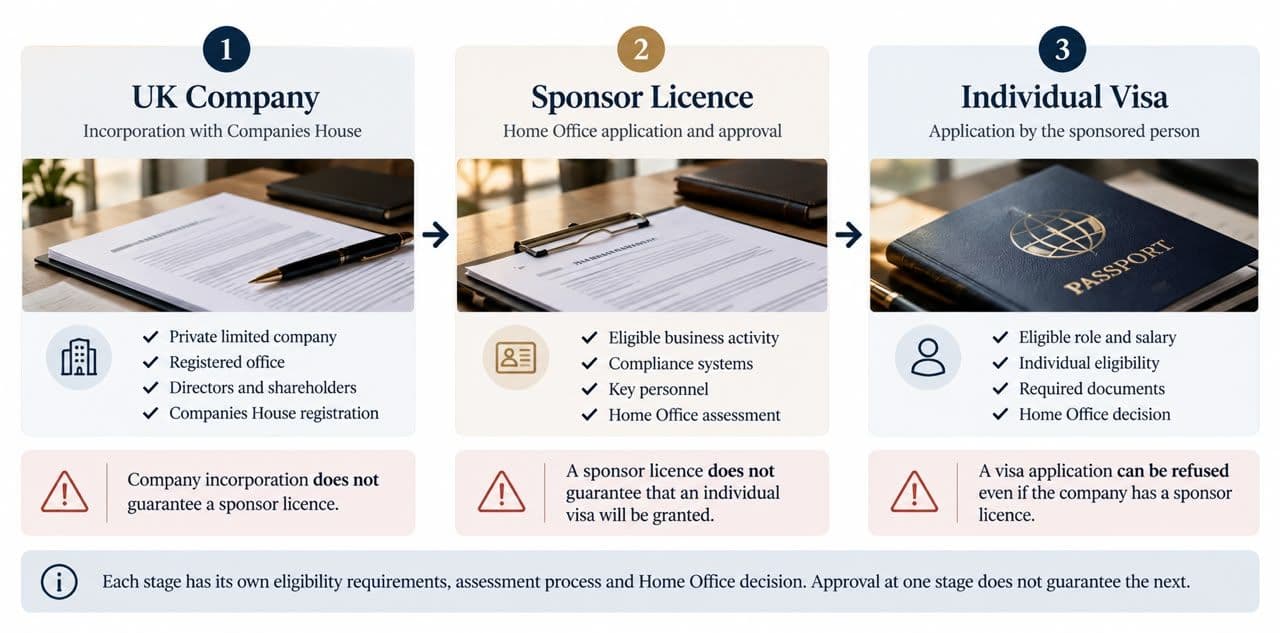
1. Company Formation and Sponsor Licensing Are Different
A UK company is incorporated through Companies House.
A sponsor licence is administered through the Home Office sponsorship system.
They answer different questions.
Companies House
Does the company meet the requirements to exist as a registered UK company?
Sponsor licensing
Does the organisation satisfy the requirements to participate in the relevant worker-sponsorship system?
A company can therefore be:
- successfully incorporated;
- active at Companies House;
- owned entirely by a non-resident;
- compliant with its corporate filing requirements;
and still not necessarily satisfy the sponsor-licence requirements.
Likewise, being a shareholder or director of a UK company does not itself create permission to work physically in Britain.
Our UK Company Formation for Non-Residents guide covers the corporate formation process.
For the immigration distinction, read Do You Need a UK Visa to Own or Run a UK Limited Company as a Non-Resident?
2. What Does the Home Office Look for?
The Home Office does not assess a sponsor-licence application simply by checking whether a company number exists.
It needs to be satisfied that the applicant is a genuine organisation operating or trading lawfully in the UK and meets the relevant sponsor requirements.
For a new international business, practical questions can therefore include:
What does the company actually do?
Is it genuinely operating or trading?
Where does the business operate?
What commercial activity exists?
Who manages the organisation?
Who will perform the sponsor-management roles?
What employment does the company genuinely require?
Can the organisation comply with its ongoing sponsor duties?
The younger and less established the company is, the more important it becomes not to confuse a Companies House registration with evidence of an operating business.
3. The 18-Month Rule New UK Companies Need to Understand
This is one of the most important points for a recently established business.
For the purposes of the Home Office supporting-document rules, an organisation that has been operating or trading in the UK for less than 18 months is treated as a “start up”.
The wording matters.
The rule concerns how long the organisation has been operating or trading in the UK, not merely how old its Companies House incorporation record is.
It does not mean:
“A new company must wait 18 months before applying.”
Instead, it means that a business within this category faces a specific documentary requirement concerning its UK business bank account.
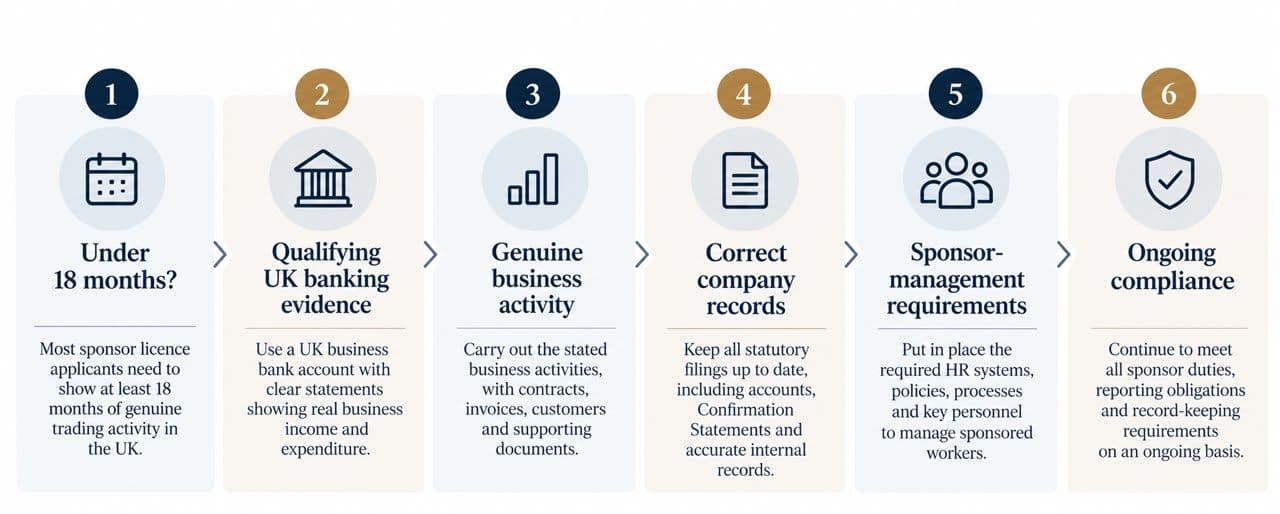
4. Does a New UK Company Need a UK Bank Account for a Sponsor Licence?
For an organisation operating or trading in the UK for less than 18 months, the Home Office supporting-document rules generally require evidence of a corporate or business account with a qualifying UK bank or building society, unless a stated exception applies.
This is important because not every financial account should be assumed to satisfy this requirement.
A UK company might use:
- a traditional bank;
- an electronic money institution;
- a payment institution;
- a multi-currency platform;
- another financial provider.
Those categories are not automatically interchangeable for this particular Home Office requirement.
A company should therefore check the actual institution and its regulatory status rather than assuming that any account carrying UK account details will qualify.
This distinction is particularly important for non-resident founders, who often begin with fintech or cross-border payment providers because their banking options can differ from those available to UK-resident directors.
For the wider banking-preparation process, use our UK Business Banking Readiness Assessment.
It explains how Seven Oak approaches corporate identity, business documentation, financial readiness, operational evidence and compliance preparation before a company approaches banking providers.
Banking readiness is not sponsor-licence eligibility. They are separate assessments.
5. A Certificate of Incorporation Is Only the Starting Point
A Certificate of Incorporation proves that the company exists.
It does not prove everything about the business behind it.
Depending on the organisation and the sponsorship route, supporting evidence can concern matters such as:
Corporate identity
The legal entity, ownership and organisational structure should be clear.
Banking
A recently established UK operation may need to meet the specific banking-evidence requirement explained above.
Commercial activity
Genuine contracts, invoices and other business records may be relevant depending on the circumstances.
Premises
Where applicable, evidence concerning the organisation’s premises can be relevant.
Regulation
A business operating in a regulated sector may need to demonstrate the registrations or permissions required for its activities.
Employment infrastructure
A licensed sponsor takes on ongoing responsibilities relating to the workers it sponsors.
The objective should never be to manufacture documents that make a newly incorporated business appear older or more established than it really is.
The company’s documentation should describe the business that genuinely exists.
6. Can the Owner or Director Live Outside the UK?
A non-resident can generally own and direct a UK private limited company.
Seven Oak’s existing UK Visa and Company Ownership guide explains that a person can potentially own or manage a UK company remotely without company ownership itself giving them permission to work physically in Britain.
Sponsor licensing introduces separate requirements.
The people appointed to manage the sponsor licence must satisfy the applicable Home Office requirements.
This creates an important distinction for a company where:
- the sole director lives overseas;
- the shareholder lives overseas;
- the business has only recently established itself in Britain;
- the UK address is supplied by a professional address provider.
A structure that is perfectly possible under UK company law does not automatically satisfy sponsor-management requirements.
Where your circumstances require an assessment of those requirements, obtain advice from an appropriately authorised UK immigration professional.
7. Can a Formation Agent Provide the Company’s Sponsor Key Personnel?
Do not treat sponsor key-personnel roles as another company-formation add-on.
The Home Office has specific rules governing who can perform sponsor-management roles and when representatives can become involved.
A professional Registered Office provider, company formation agent or business consultant should therefore not be assumed to solve a company’s sponsor-management requirements merely because they have a UK address or UK staff.
This is particularly important for international founders operating entirely from overseas.
Seven Oak Prestige does not provide UK-based sponsor key personnel as a product.
Where the composition of your proposed sponsor-management team needs to be assessed, that should be discussed with an appropriately authorised immigration professional.
8. A Registered Office Is Not the Same as UK Operations
Every UK limited company needs an appropriate Registered Office.
But the Registered Office has a specific corporate purpose.
It does not automatically mean that:
- employees work there;
- directors work there;
- management takes place there;
- customers are served there;
- the business has operational premises there;
- the company is ready to become a licensed sponsor.
This distinction matters especially for non-resident founders using professional address services.
Our UK Registered Office vs Director Service Address for Non-Residents guide explains the difference between the Registered Office, Director Service Address, residential address, business address and operating address.
The Home Office can also carry out compliance checks.
For businesses operating virtually with little or no physical office space, the sponsor guidance indicates that a compliance check is highly likely before a decision, potentially including a visit to the Authorising Officer’s physical address.
The practical lesson is simple:
Registered Office ≠ operating premises ≠ sponsor readiness.
A genuine remote company does not need to pretend that its Registered Office is something it is not.
Its actual operating model should be described accurately.
9. Can a Founder Form a UK Company and Sponsor Themselves?
This is one of the most important sections of this guide.
There is no separate UK immigration route officially called a “self-sponsorship visa.”
More importantly, the Home Office sponsor guidance directly considers the risk of a company being established mainly to facilitate an overseas person’s entry or residence in the UK.
The guidance includes an example involving a foreign national living abroad who establishes a company at Companies House, appoints someone in the UK to perform a sponsor-management role and then seeks sponsorship through that company.
The Home Office explains why circumstances of this kind can lead it to question whether the organisation genuinely exists for a commercial purpose independent of the person’s immigration objective.
That does not mean that every overseas founder is permanently prohibited from being sponsored by a company they own.
It does mean that this should never be marketed as:
“Register a UK company and sponsor yourself.”
Nor should a founder assume:
“Once Companies House approves my company, I can use it to get a UK work visa.”
Those propositions confuse corporate registration with immigration eligibility.
If your objective involves moving to Britain, working for your own company, obtaining sponsorship or selecting an immigration route, obtain advice from an appropriately authorised immigration professional before building the company around that objective.
For the underlying company-law distinction, see Do You Need a UK Visa to Own or Run a UK Limited Company as a Non-Resident?
10. Does the Company Need to Be Genuinely Trading?
The Home Office looks beyond formal company registration.
The commercial reality of the organisation matters.
Depending on the circumstances, that can include matters such as:
- what the business genuinely sells;
- who its customers are;
- contracts;
- transactions;
- operational activity;
- staffing;
- the role for which sponsorship is proposed;
- whether that role makes commercial sense for the organisation.
A new company should therefore avoid creating:
- artificial transactions;
- artificial employment;
- misleading operating addresses;
- exaggerated trading history;
- contracts that do not reflect genuine arrangements;
- documentation designed only to create the appearance of UK substance.
The goal is not to look established.
The goal is to accurately evidence the business that genuinely exists.
For companies that have only recently incorporated, our What Happens After You Register a UK Company as a Non-Resident? guide explains the wider post-incorporation work across banking, accounting, Companies House, tax, VAT, EORI and operational preparation.
11. What If the New UK Company Is a Subsidiary of an Established Overseas Business?
This is a different commercial situation from an individual creating a new company with no existing operating business behind it.
Consider:
Established overseas company
→ UK subsidiary
→ UK customers, contracts, employees or operations
The UK subsidiary itself may be newly incorporated while the wider business group has operated overseas for years.
That does not automatically determine sponsor-licence eligibility, but it changes the commercial context considerably.
Before establishing the UK entity, the overseas company should also determine whether it actually needs:
A UK subsidiary
A separate UK legal entity owned by the overseas parent.
A UK establishment or branch
The overseas company itself operates through a registered UK presence.
Direct trading
The overseas company supplies the UK without establishing a separate UK entity, where legally and commercially appropriate.
Seven Oak’s UK Subsidiary vs Branch for Overseas Companies guide compares these structures across legal identity, liability, contracts, employees, banking, Companies House filings and long-term UK operations.
The corporate structure should follow the genuine UK expansion plan rather than being selected solely because of an expected immigration outcome.
12. UK Expansion Worker Is Not a Shortcut for Every New Company
UK Expansion Worker is a separate immigration route designed for qualifying overseas businesses expanding into Britain.
It should not be interpreted as:
“I have just registered a UK company and have not started trading, therefore UK Expansion Worker applies.”
The route has specific requirements concerning the overseas business, its existing trading activity, its UK footprint and its planned expansion.
The overseas organisation must normally have an established overseas trading history, subject to specific exceptions.
A newly incorporated UK company owned by an individual with no qualifying established overseas business should therefore not assume that UK Expansion Worker provides an alternative route.
Where an established foreign business is planning a genuine British operation, the corporate-structure side can be explored through our UK Subsidiary vs Branch for Overseas Companies guide.
Whether UK Expansion Worker, Skilled Worker or another immigration route is appropriate is an immigration question and should be assessed by an appropriately authorised adviser.
13. How Much Does a UK Sponsor Licence Cost in 2026?
The current Home Office application fee for a Worker sponsor licence is:
Small or charitable sponsor
£611
Medium or large sponsor
£1,682
These are Home Office fees.
They are separate from potential costs relating to:
- company formation;
- banking;
- payroll;
- accounting;
- immigration advice;
- Certificates of Sponsorship;
- the Immigration Skills Charge;
- visa applications;
- other employment or immigration requirements.
A Certificate of Sponsorship is also a separate item from the sponsor-licence application.
The relevant fees should always be checked on GOV.UK immediately before an application because immigration fees can change.
14. Sponsor Licence, Certificate of Sponsorship and Visa Are Not the Same Thing
This distinction is easy to lose when reading commercial immigration websites.
Sponsor Licence
Relates to the organisation’s ability to participate in the relevant sponsorship system.
Certificate of Sponsorship
An electronic sponsorship record assigned by a licensed sponsor in appropriate circumstances.
Visa or immigration permission
The individual’s immigration application.
Approval at one stage does not automatically guarantee the next.
This is why a founder should never treat the process as:
Company → Sponsor Licence → Visa guaranteed.
They are separate legal and administrative decisions.
15. Does a Sponsor Licence Expire?
For ordinary sponsor licences, the previous routine renewal model no longer generally applies.
An ordinary licence can continue while the organisation remains eligible and compliant, unless it is revoked, surrendered or otherwise ceases under the applicable rules.
Certain routes operate differently.
For example, UK Expansion Worker and Scale-up sponsor licences are subject to a four-year limit.
The more important point for an employer is that obtaining a sponsor licence creates ongoing responsibilities.
Approval is the beginning of sponsor compliance, not the end.
16. What Happens After a Sponsor Licence Is Granted?
A licensed sponsor must maintain appropriate systems and continue meeting its Home Office responsibilities.
These include requirements relating to areas such as:
- record keeping;
- monitoring sponsored workers;
- reporting relevant changes;
- maintaining appropriate HR systems;
- complying with immigration requirements;
- cooperating with Home Office checks.
The Home Office can carry out compliance checks before or after a licence is granted.
A company should therefore not approach sponsorship as:
“Submit the application, receive the licence, finished.”
It is an ongoing compliance function within the employer.
17. What Should an International Founder Organise on the Company Side?
Before treating immigration sponsorship as the next step, make sure the underlying UK company is properly organised.
Companies House records
Directors, shareholders, PSCs, company addresses and corporate information should accurately reflect the company.
Companies House identity verification
Directors and PSCs should comply with the identity-verification requirements that apply to them.
International directors who need practical assistance can review Seven Oak’s Companies House Identity Verification Assistance service. The current service is specifically designed for directors and PSCs, including non-UK residents.
Statutory addresses
Understand exactly what each address represents.
Our UK Registered Office vs Director Service Address for Non-Residents guide explains the distinction.
If you do not have your own UK premises, also read UK Company Formation Without Your Own UK Address. It explains how a compliant professional address can be used without pretending that the founder lives or operates there.
Banking
Understand what type of account the company actually has and whether it meets any particular requirement for which you intend to rely on it.
For the wider preparation process, use the UK Business Banking Readiness Assessment.
Commercial documentation
Websites, contracts, invoices, company descriptions and business records should describe the real activity consistently.
Ongoing compliance
A newly incorporated company may need to consider Companies House filings, accounting, Corporation Tax, payroll, VAT, EORI and other obligations depending on its activities.
The Post-Incorporation Checklist for Non-Resident Founders covers these areas in more detail.
These are company-establishment and corporate-readiness matters.
They should not be confused with an assessment of sponsor-licence or visa eligibility.
18. Seven Mistakes Non-Resident Founders Should Avoid
1. Forming a UK company because someone promised it would provide a visa
Company formation does not grant immigration permission.
2. Assuming a Companies House certificate proves UK operations
It proves incorporation, not the full commercial reality of the organisation.
3. Assuming every fintech or payment account satisfies the start-up banking requirement
The Home Office requirement for businesses operating or trading in the UK for less than 18 months is more specific.
4. Presenting a Registered Office as operating premises
A statutory company address and a genuine operating location are different concepts.
5. Assuming a formation agent can simply become the required UK sponsor personnel
Sponsor-management roles have separate Home Office requirements.
6. Creating artificial activity to make the company appear established
Documents and transactions should reflect genuine commercial activity.
7. Assuming UK Expansion Worker applies to any new overseas-owned UK company
It is a specific immigration route with its own requirements concerning the overseas business and proposed UK expansion.
19. Where Seven Oak Prestige Can Help
Seven Oak Prestige supports international founders and overseas businesses on the UK company-establishment and corporate-support side.
Depending on the project, this can include:
- UK company formation;
- UK subsidiary establishment;
- Registered Office;
- Director Service Address;
- Virtual Business Address;
- Companies House administration;
- Companies House identity-verification assistance;
- KYC preparation;
- business-banking readiness;
- VAT and EORI support where applicable;
- post-incorporation coordination.
Seven Oak Prestige does not present UK company incorporation as a route to a visa.
We do not guarantee:
- sponsor-licence approval;
- Certificate of Sponsorship allocation;
- Skilled Worker approval;
- UK Expansion Worker approval;
- any other immigration outcome.
If you need to establish the corporate side of a genuine UK operation, UK Company Formation for Non-Residents is the best starting point.
For an established overseas company, start with UK Subsidiary vs Branch for Overseas Companies .
Need Sponsor-Licence or Visa Advice?
Sponsor-licence eligibility, immigration strategy, sponsored roles and visa applications are separate from company formation.
Where immigration advice is required, Seven Oak Prestige can connect you with an appropriately authorised UK immigration professional.
The immigration professional will assess your circumstances independently. Seven Oak Prestige does not determine immigration eligibility or guarantee any Home Office outcome.
Speak to a Regulated Immigration Adviser
Where an introduction involves a commercial referral arrangement, any applicable referral relationship or fee will be disclosed transparently.
Frequently Asked Questions
Can a company incorporated recently get a sponsor licence?
Potentially.
Being recently incorporated does not automatically prevent an organisation from applying. However, incorporation alone does not establish sponsor eligibility.
A company operating or trading in the UK for less than 18 months also falls within the relevant Home Office start-up documentary rules.
Does a new company need to wait 18 months before applying?
No.
The 18-month provision is not a waiting period.
It identifies businesses that have been operating or trading in the UK for less than 18 months for particular documentary requirements.
Does a new company need a UK business bank account?
For an organisation operating or trading in the UK for less than 18 months, the Home Office generally requires the specified qualifying UK corporate or business bank-account evidence, subject to applicable exceptions.
Is any fintech or EMI account sufficient?
Do not assume so.
The Home Office uses specific regulatory criteria for the start-up banking evidence. The institution relied upon should be checked against the current requirement.
For general banking preparation rather than sponsor eligibility, use our UK Business Banking Readiness Assessment.
Can a non-resident own the UK company?
Generally, yes.
A non-resident can generally own a UK private limited company. Ownership itself does not create immigration permission or determine sponsor-licence eligibility.
Read Do You Need a UK Visa to Own or Run a UK Limited Company as a Non-Resident? for the full distinction.
Can the sole director live overseas?
UK company law does not generally require the director of an ordinary private limited company to reside in the UK.
Sponsor licensing has separate requirements concerning the people who manage the sponsor licence.
Can my formation agent be my Authorising Officer?
Do not assume so.
Home Office rules place specific restrictions on sponsor key personnel and representatives. Where your proposed management structure needs to be assessed, obtain advice from an appropriately authorised immigration professional.
Can I create a UK company specifically to sponsor myself?
This is a high-risk assumption.
The Home Office guidance specifically addresses circumstances in which an overseas person creates a UK company and then seeks to use that organisation to facilitate their own entry or residence.
Company incorporation should therefore not be marketed or treated as an automatic self-sponsorship route.
Is “self-sponsorship” a UK visa category?
No official UK immigration category is called a self-sponsorship visa.
The phrase is used commercially by some advisers, but it should not be interpreted as a separate visa route or an entitlement created by owning a company.
Does a Registered Office prove that my business operates in the UK?
No.
A Registered Office is the company’s statutory address. It does not automatically prove physical operating premises or genuine UK trading.
See UK Registered Office vs Director Service Address for Non-Residents.
How much does a sponsor licence cost in 2026?
The current Worker sponsor-licence application fee is £611 for a small or charitable sponsor and £1,682 for a medium or large sponsor.
Always confirm the applicable fee on GOV.UK immediately before applying.
How much does a Certificate of Sponsorship cost?
The current Worker Certificate of Sponsorship fee is £525.
Additional costs can apply depending on the route, worker and circumstances.
Does an ordinary sponsor licence expire?
Ordinary sponsor licences generally continue while the organisation remains eligible and compliant unless they are revoked, surrendered or otherwise cease under the applicable rules.
UK Expansion Worker and Scale-up licences operate differently and are limited to four years.
Can a newly formed UK subsidiary of an established overseas company apply?
A newly established subsidiary is not automatically excluded merely because the UK company is new.
However, its sponsor-licence position must still be assessed against the applicable requirements.
If your first question is how the overseas parent should establish its UK presence, read UK Subsidiary vs Branch for Overseas Companies.
Is UK Expansion Worker suitable for any new overseas entrepreneur?
No such assumption should be made.
UK Expansion Worker is designed for qualifying overseas businesses expanding into Britain and has its own requirements concerning the established overseas business and UK expansion.
Can Seven Oak Prestige apply for my sponsor licence?
Seven Oak Prestige’s services focus on UK company establishment, Companies House administration, statutory addresses, identity-verification assistance, KYC preparation, banking readiness and related corporate support.
Where sponsor-licence eligibility, immigration strategy, sponsored roles, visa applications or other immigration advice are involved, we can connect you with an appropriately authorised UK immigration professional.
The immigration professional assesses the matter independently.
Final Takeaway
A newly formed UK company is not automatically too young to apply for a sponsor licence.
But the correct sequence is not:
Form a UK company → receive a sponsor licence → receive a visa.
These are separate processes.
A business operating or trading in the UK for less than 18 months can face specific documentary requirements.
Its sponsor-management arrangements must satisfy the applicable Home Office rules.
Its business activity must be genuine.
Its proposed employment must satisfy the relevant sponsorship requirements.
And where a company appears to have been established mainly to facilitate an overseas founder’s entry or residence in Britain, that can create a serious issue.
For international founders, the safest principle is:
Build the UK company because there is a genuine commercial reason for the business to exist. Treat immigration as a separate regulated question.
Seven Oak Prestige can support the UK company-establishment, Companies House, address, identity-verification and banking-readiness side of a genuine UK operation.
Where you require sponsor-licence or visa advice, we can connect you with an appropriately authorised UK immigration professional.
Related Seven Oak Prestige Guides
UK Company Formation for Non-Residents
For international founders who are still planning their UK company.
Do You Need a UK Visa to Own or Run a UK Limited Company as a Non-Resident?
For the distinction between UK company ownership, directorship and immigration permission.
UK Subsidiary vs Branch for Overseas Companies
For established overseas businesses deciding how to structure a genuine UK operation.
UK Business Banking Readiness Assessment
For international companies preparing their corporate and financial profile before approaching banking providers.
UK Registered Office vs Director Service Address for Non-Residents
For understanding statutory addresses, residential addresses and genuine operating locations.
UK Company Formation Without Your Own UK Address
For founders who need a compliant UK address structure while continuing to live overseas.
Companies House Identity Verification Assistance
For directors and PSCs who need practical assistance completing Companies House identity verification.
What Happens After You Register a UK Company as a Non-Resident?
For the wider post-incorporation process covering banking, accounting, Companies House, tax, VAT, EORI and ongoing administration.
About the Author
Isaac Jackson
Founder & Managing Director — Seven Oak Prestige Ltd
Isaac Jackson supports international founders and overseas businesses establishing and operating UK companies, including founders requiring support with company formation, statutory addresses, Companies House administration, KYC preparation, compliance coordination and banking readiness.
Seven Oak Prestige Ltd
Company Registration No. 16903092
Registered Office: 124 City Road, London EC1V 2NX, United Kingdom
Methodology
This guide was prepared specifically to answer:
Can a newly formed UK company obtain a sponsor licence, particularly where the company is owned or directed by an overseas founder?
The article was reviewed against current Home Office sponsor guidance and supporting-document requirements.
Particular attention was given to the distinction between:
company incorporation
genuine UK business activity
sponsor licensing
and
individual immigration permission.
The article deliberately does not determine whether a particular company or individual qualifies for a sponsor licence or immigration route.
Last reviewed: 28 September 2026
Disclaimer
This article provides general information about UK company establishment and the sponsor-licensing framework.
It does not constitute immigration, legal, tax or employment advice and does not assess the eligibility of any particular company or individual for a sponsor licence, Certificate of Sponsorship or visa.
Immigration rules, fees and sponsor guidance can change. Where you require advice about sponsor-licence eligibility, immigration strategy, a sponsored role, a visa application or representation before the Home Office, obtain advice from an appropriately authorised professional.