
UK Ltd vs LLC vs LLP: Which Is Best for Non-Residents? | 2026

UK Ltd vs LLC vs LLP: Which Structure Should a Non-Resident Founder Choose?
A UK Ltd, US LLC and UK LLP are not three versions of the same company.
They solve different problems.
For most international founders, the decision should not begin with:
“Which structure pays the least tax?”
or:
“Which one gives me Stripe?”
Start instead with:
Where do I live?
Where will the business actually operate?
Will I have one founder or several?
Where are my customers?
How do I want ownership and profits structured?
Which country should logically sit at the centre of the business?
The entity should follow the commercial reality.
Not the other way around.
If you first need the basic definition of a UK Limited Company, read What Does “Ltd” Mean in the UK?.
Quick Answer: UK Ltd vs US LLC vs UK LLP
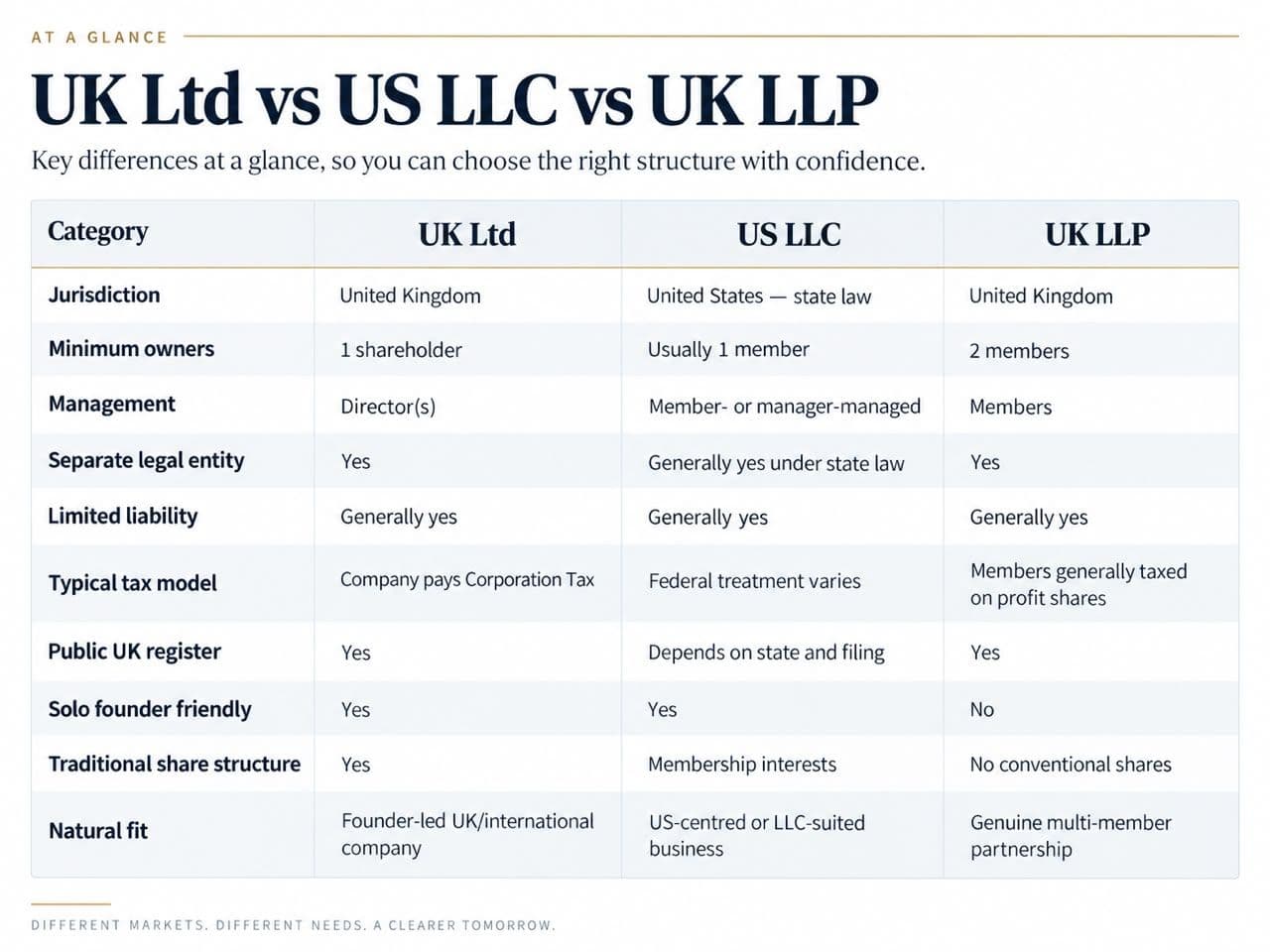
The Short Decision
Consider a UK Ltd if:
you want a conventional company with shares, directors, one or more founders and a genuine UK or international commercial rationale.
Consider a US LLC if:
the United States is commercially relevant and the LLC’s state-law and tax characteristics genuinely fit your residence and business.
Consider a UK LLP if:
two or more genuine members want to operate together through a partnership-style structure with limited liability.
None is universally “best”.
1. UK Ltd: Best for a Conventional Company Structure
A UK private limited company is usually the most straightforward of these three structures to understand.
It can have:
1 shareholder
- ●
1 individual director
and the same founder can hold both roles.
Ownership is represented through shares.
This makes a Ltd particularly intuitive where you expect:
- a solo founder;
- co-founders with defined percentages;
- future investors;
- dividends;
- a parent/subsidiary structure;
- clearly separated ownership and management.
The company is a separate legal person and is subject to UK corporate filing and tax obligations.
For 2026, UK Corporation Tax is not simply “19%”.
The small-profits rate is 19% for qualifying profits up to £50,000, the main rate is 25% above £250,000, and marginal relief can apply between those levels. The thresholds can also be affected by associated companies.
For an overseas founder, there may separately be tax consequences in the founder’s country of residence.
UK Ltd is often worth considering when:
- you want a recognisable corporate share structure;
- one founder needs to own 100%;
- investors may enter later;
- Britain is commercially relevant;
- international clients contract with the company;
- you want a conventional company rather than partnership economics.
If you already know this is the structure you need, continue with our UK Company Formation for Non-Residents — Complete 2026 Guide.
2. US LLC: Flexible — but Frequently Oversimplified Online
A US LLC is a Limited Liability Company created under US state law.
Its owners are normally called:
members
rather than shareholders.
A major reason LLCs attract international founders is flexibility.
But this is also where online advice becomes dangerous.
You will often see:
“US LLC = pass-through = 0% tax.”
That is not a universal rule.
For US federal income-tax purposes, an LLC’s classification can depend on:
- the number of members;
- elections made with the IRS;
- who owns it;
- the nature and source of income;
- whether the business has US activities;
- other relevant facts.
For example, a domestic single-member LLC is generally disregarded for federal income-tax purposes by default unless it elects corporate treatment.
A multi-member domestic LLC is generally treated as a partnership by default unless it elects otherwise.
That does not mean a foreign owner automatically has no US filing or tax obligations.
And it certainly does not mean the owner’s home country will ignore the LLC.
US LLC may merit consideration when:
- the US is an important commercial market;
- there is a genuine US business rationale;
- the desired ownership model suits an LLC;
- the founder understands both US and home-country tax treatment;
- US contracts, operations or infrastructure are commercially relevant.
Do not form one solely because a social-media post says it is “tax free”.
3. UK LLP: A Different Structure Entirely
LLP means:
Limited Liability Partnership.
A UK LLP is not simply a Ltd with two founders.
It combines:
- separate legal personality;
- limited liability for members;
- partnership-style internal organisation.
And there is one immediate structural difference:
a UK LLP needs at least two members.
So if you are a solo founder, a UK LLP is generally not your equivalent of a one-person Ltd.
For tax purposes, UK LLPs are generally treated as partnerships where the relevant conditions are met.
This means profits are normally allocated to the members, with each member responsible for tax on their share rather than the LLP simply operating like an ordinary corporation paying Corporation Tax on all profits.
Cross-border membership can make that analysis substantially more complicated.
UK LLP can make sense when:
- there are genuinely two or more members;
- profit-sharing is central to the relationship;
- partnership-style governance is desired;
- the members understand how profits will be allocated;
- advisers have considered the tax treatment of each member.
It is frequently seen in professional and partnership-style businesses.
It should not be chosen simply because the letters LLP sound similar to LLC.
They are different structures in different legal systems.
4. UK Ltd vs US LLC vs UK LLP: The Real Differences
Ownership
UK Ltd
Owned through shares.
You can easily describe:
- Founder A — 70%
- Founder B — 30%
US LLC
Owned through membership interests.
Rights are normally governed substantially through the applicable state framework and operating agreement.
UK LLP
Owned and operated through membership, with economic and governance arrangements normally addressed in the LLP agreement.
Best for conventional equity?
UK Ltd.
Especially where shares, investors and percentage ownership are central to the business.
Solo Founder
UK Ltd
Yes.
US LLC
Generally yes — single-member LLCs are common.
UK LLP
No. At least two members are required.
Best for a solo international founder?
Usually the first structural comparison is therefore:
UK Ltd vs US LLC
not LLP.
5. Which Structure Is Best for Tax?
This is the wrong question without knowing where you live.
A founder living in:
India
can receive a different tax outcome from a founder living in:
France
even when they own exactly the same foreign company.
Why?
Because you potentially have two systems interacting:
entity jurisdiction
- ●
founder’s country of residence
A UK Ltd is normally within the UK Corporation Tax regime.
A UK LLP is generally partnership-taxed, with members taxed on their allocated shares under the applicable rules.
A US LLC can receive different US federal classifications depending on its ownership and elections.
But then your country of residence may classify that foreign structure differently again.
That can affect:
- personal income tax;
- foreign tax credits;
- distributions;
- reporting;
- controlled foreign company rules;
- management and control;
- permanent establishment;
- overseas investment requirements.
The right tax question is:
“How will this structure be treated in every jurisdiction that actually matters to me?”
Not:
“Which jurisdiction advertises the lowest headline tax?”
6. Which Is Better for Banking, Stripe and Payments?
None of the three structures guarantees banking or payment-provider approval.
A company may be legally incorporated and still be declined by:
- a bank;
- EMI;
- Stripe;
- Wise;
- Revolut;
- Airwallex;
- PayPal;
- another provider.
Providers can examine:
- owner residence;
- business activity;
- transaction countries;
- website;
- source of funds;
- customer profile;
- ownership;
- sanctions exposure;
- operating presence.
UK Ltd
Can be suitable for UK and international financial infrastructure, subject to provider eligibility.
US LLC
Can be relevant for US-centred infrastructure, but US incorporation alone does not guarantee a US account or payment processor.
UK LLP
Can obtain business financial services where eligible, but its partnership ownership and member structure may require different KYC/KYB documentation.
If your intended structure depends entirely on one provider approving you, the structure is probably being chosen for the wrong reason.
For UK banking considerations, read UK Business Banking for Non-Residents — Banks, Fintechs & Eligibility.
7. Which Is Better for Investors?
For a traditional founder-investor relationship, a UK Ltd often provides the clearest of these UK structures because ownership is divided into shares.
You can potentially structure:
- founder shares;
- investor shares;
- different share classes;
- voting rights;
- economic rights.
A US LLC can also accommodate sophisticated ownership arrangements through membership interests and an operating agreement.
However, investor preferences vary materially.
A UK LLP is generally less intuitive for a conventional startup equity round because it is fundamentally a partnership structure rather than a share company.
So if the plan is:
Founder → seed investors → future equity rounds
the structure should be considered before incorporation, not reconstructed after investors arrive.
For UK company ownership specifically, see How to Structure Shares and Directors in a UK Ltd as a Non-Resident Founder.
8. Which Structure Is Best by Founder Type?
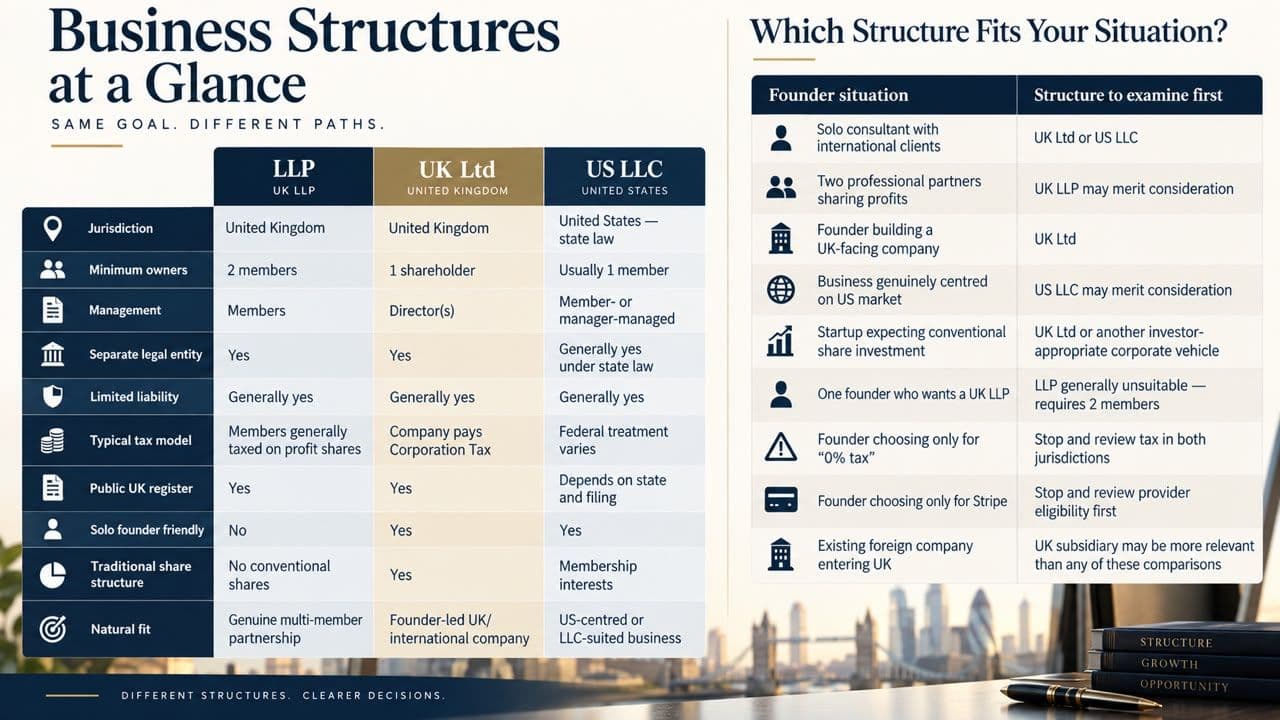
This table is deliberately not:
UK Ltd = good
US LLC = better
LLP = cheap
The structure must reflect the actual business.
9. For Indian Founders: Do Not Compare Only UK Tax vs US Tax
For an Indian resident, there is an additional layer:
India.
An Indian founder considering a UK Ltd or US LLC may still need to analyse:
- FEMA;
- RBI Overseas Investment rules;
- funding of the foreign entity;
- ODI;
- LRS where relevant;
- India-side reporting;
- foreign assets;
- tax residence;
- management and control.
So:
US LLC = no US federal tax in one particular scenario
does not mean:
Indian founder = no Indian tax or reporting.
Likewise:
UK company = 19% Corporation Tax in one profit band
does not answer the founder’s total India–UK tax position.
If you are based in India and deciding whether a foreign structure is appropriate, start with How to Start a UK Company from India — Complete 2026 Guide.
If the real decision is India vs UK rather than UK vs US, use our Indian Private Limited vs UK Limited Company Comparison.
10. The Decision Framework
Before choosing any entity, answer these seven questions.
1. Where do you live?
Your personal tax and reporting obligations begin here.
2. Where will management actually happen?
Incorporation address and real management are not necessarily the same thing.
3. Where are your customers?
UK? US? EU? India? Global?
4. How many genuine owners are there?
One founder immediately makes a UK LLP a poor fit.
5. How will ownership work?
Shares?
Membership interests?
Profit-sharing partnership?
6. Will you raise investment?
If yes, understand the investors’ expected structure before incorporating.
7. Which infrastructure do you genuinely need?
Banking, payments and platforms matter — but provider eligibility should be checked independently.
The answer should emerge from those questions.
11. UK Ltd vs LLC vs LLP: Final Verdict
There is no universal winner.
Consider a UK Ltd when:
You want a conventional company with shares, one or more founders, clear ownership, potential investors and a genuine UK/international business rationale.
Consider a US LLC when:
The United States genuinely matters to the business and the LLC’s legal and tax characteristics fit both your US position and your country of residence.
Consider a UK LLP when:
At least two genuine members want a partnership-style business with limited liability and understand the member-level tax consequences.
Do not choose any of them primarily because:
- someone promised zero tax;
- someone promised Stripe;
- someone promised a bank account;
- one jurisdiction is fashionable on YouTube;
- incorporation takes only a few hours.
Formation is easy.
Choosing the wrong structure can be expensive to unwind.
Frequently Asked Questions
Is a UK Ltd better than a US LLC?
Not universally.
A UK Ltd is a conventional share company within the UK corporate-tax system.
A US LLC is a state-law entity whose federal tax classification can vary.
The better structure depends on your residence, customers, activities, tax position and long-term plans.
Is an LLC the same as an LLP?
No.
A US LLC and UK LLP are different structures under different legal systems.
A UK LLP also requires at least two members.
Can one person own a UK Ltd?
Yes.
A UK private company limited by shares can generally have one shareholder, who may also act as its sole individual director.
Can one person form a UK LLP?
No.
A UK LLP requires at least two members.
Is a US LLC always tax free for non-residents?
No.
That is an unsafe generalisation.
US tax treatment depends on the LLC’s classification and facts, while the owner’s country of residence may impose its own tax and reporting obligations.
Does a UK Ltd always pay 19% Corporation Tax?
No.
For 2026, qualifying small profits can fall within the 19% small-profits rate, while the main rate is 25%, with marginal relief potentially applying between the relevant thresholds.
The actual position depends on the company’s circumstances.
Which is better for Stripe: UK Ltd or US LLC?
Neither structure guarantees Stripe approval.
Stripe applies its own eligibility, KYC, business-model and geographic requirements.
Choose the entity around your business first.
Is a UK LLP better for two founders?
Sometimes.
If two genuine business partners specifically want partnership-style profit allocation and governance, an LLP can merit consideration.
If they want conventional share ownership, future investors or startup-style equity, a Ltd may be more natural.
Review the Structure Before You Incorporate
The most expensive structural mistake is rarely paying too much to register a company.
It is creating the wrong entity in the wrong jurisdiction and discovering the problem after:
- customers arrive;
- money starts moving;
- investors enter;
- tax filings become due;
- banking has already been set up.
Seven Oak Prestige helps international founders assess whether a UK Limited Company genuinely fits their intended structure before incorporation.
Where the issue requires US or home-country legal or tax analysis, that should be reviewed with an appropriately qualified specialist in the relevant jurisdiction.
About the Author
Isaac Jackson — Founder & Managing Director, Seven Oak Prestige Ltd
Isaac Jackson has more than three years of hands-on experience supporting international founders with UK company formation, Companies House processes, address solutions, compliance preparation and banking readiness.
His work includes helping founders assess whether a UK corporate structure fits their ownership, residence, international operations and longer-term business plans before incorporation.
Editorial Methodology
Last reviewed: 9 September 2026
This guide was prepared after reviewing current:
- Companies House guidance on UK private limited companies and LLPs;
- HMRC guidance on Corporation Tax and partnership taxation;
- IRS guidance on LLC federal tax classification;
- US Small Business Administration material on business structures;
- live 2026 search results for UK Ltd vs US LLC and related non-resident founder queries;
- Seven Oak Prestige’s existing UK company structure, India and non-resident content.
The article deliberately distinguishes:
legal structure
from
tax classification
from
banking eligibility
from
founder residence
from
commercial fit.
It does not treat a US LLC as automatically tax-free, a UK Ltd as automatically taxed at one fixed rate, or any entity as guaranteeing banking or payment-provider access.
Important Disclaimer
This guide provides general educational information and does not constitute UK, US or international legal, tax, accounting, investment or financial advice.
US LLC rules vary by state and federal tax treatment depends on the entity’s facts and elections.
UK LLP tax outcomes can depend on the members, their residence, activities and other circumstances.
International founders may also have tax, foreign-investment, reporting or controlled-foreign-company obligations in their country of residence.
Seven Oak Prestige Ltd provides UK company formation, corporate support, compliance preparation and banking-readiness services. Where specialist UK, US or home-country tax or legal advice is required, an appropriately qualified professional should be consulted.
Banking and payment-provider approval remains independent and cannot be guaranteed.