
UK Company Formation for Russian Citizens in Thailand - 2026 Guide

UK Company Formation for Russian Citizens Living in Thailand: 2026 Guide
If you are a Russian citizen legally living in Thailand, you can potentially form and own a UK private limited company.
The key point is that Russian nationality and Thai residence are two different facts.
For company formation and later banking or payment-provider applications, you may need to prove both:
- who you are; and
- where you genuinely live.
A Russian passport proves identity and nationality.
It does not by itself prove that you currently live in Thailand.
That is why additional Thai residence evidence can become important.
Quick Answer
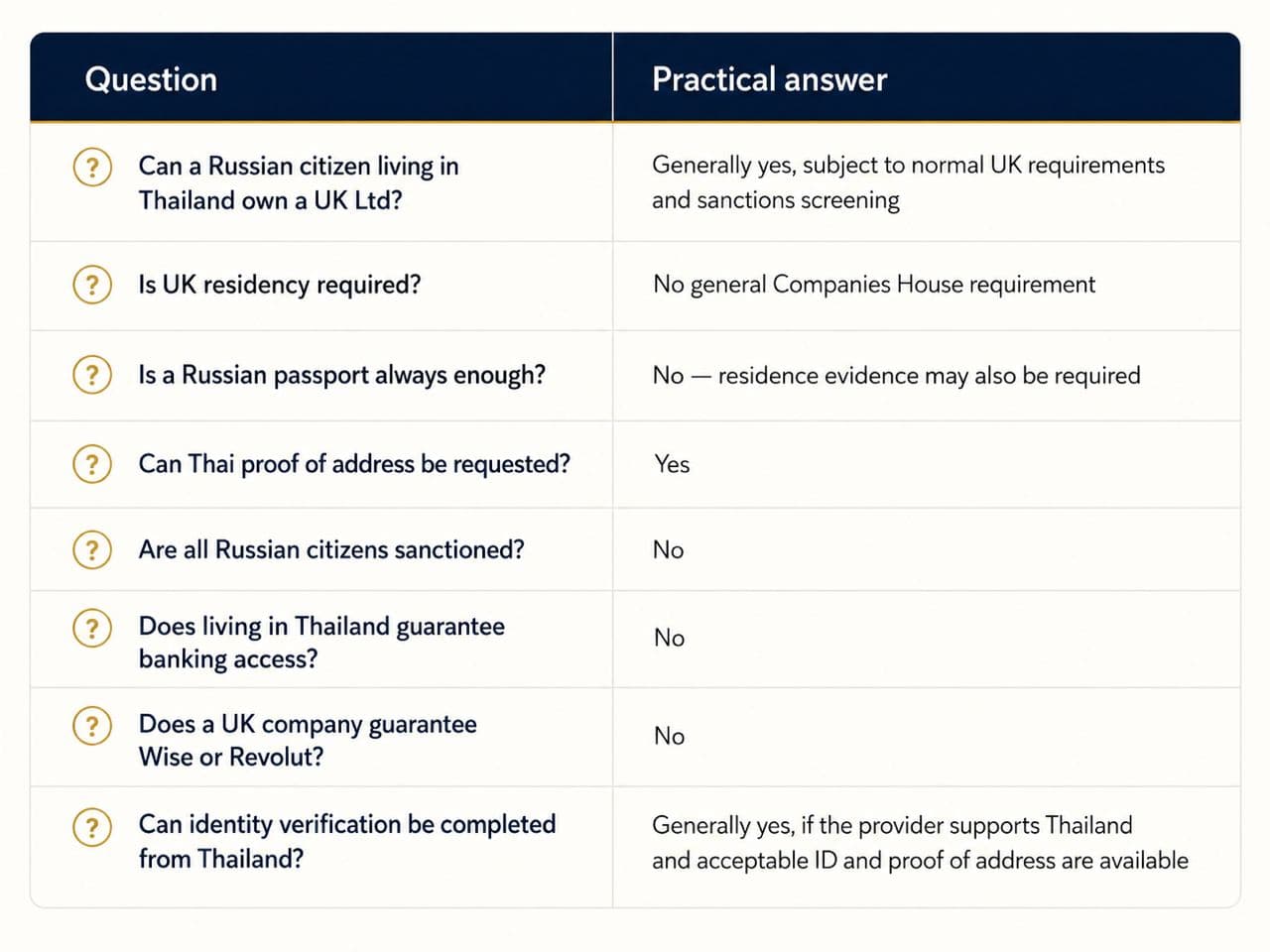
Russian Nationality vs Thai Residence
This is the most important distinction.
A founder may be:
Russian by nationality
but:
resident in Thailand
Those two facts can affect different parts of onboarding.
Companies House focuses on the company, directors, PSCs and identity verification.
Banks, fintechs and professional service providers may additionally assess:
- nationality
- country of residence
- residential address
- ownership
- source of funds
- business activity
- sanctions exposure
- expected transactions
Living outside Russia can materially change the founder’s current profile, but it does not remove the need for sanctions screening.
Russian nationality by itself does not mean that someone is automatically a sanctioned person. The UK operates targeted sanctions and wider Russia-related restrictions, and relevant individuals and entities still need to be screened against the applicable sanctions framework.
Can a Russian Citizen Living in Thailand Form a UK Company?
In general, UK company law does not require a director to live in the UK.
A private limited company can usually be formed remotely, provided the applicable company information, address and identity-verification requirements are satisfied.
The current online Companies House incorporation fee is:
£100
Typical incorporation information includes:
- company name
- director details
- shareholder details
- PSC information
- business activity
- registered office
- identity-verification information
The company itself must still have an appropriate UK registered office.
Your personal residence can remain in Thailand.
Why a Russian Passport May Not Be Enough
A passport normally establishes:
- identity
- nationality
- date of birth
It does not normally establish your current Thai residential address.
For international or higher-scrutiny profiles, a provider may therefore ask for additional evidence showing that you genuinely live where you say you live.
Examples may include:
- recent utility bill
- Thai bank statement
- Thai driving licence
- residence or immigration document
- government-issued correspondence
- another accepted official document showing the same address
The exact evidence required depends on the verification route and provider.
In some cases, one proof of address may not be sufficient and an additional document may be requested.
The strongest application is a consistent one.
Your:
name + residential address + country of residence
should match across the application and supporting documents.
What Makes Strong Thai Residence Evidence?
Useful residence evidence will normally show:
- your full legal name
- your Thai residential address
- the issuing authority or institution
- a recent issue date where applicable
- enough information for the document to be independently reviewed
A utility bill can be useful.
A Thai driving licence, residence document or immigration document may provide additional support where further evidence is required.
Avoid relying on:
- hotel bookings
- temporary accommodation records
- documents belonging to another person
- cropped screenshots with no issuer details
- documents showing a different address from the application
What About the Destination Thailand Visa (DTV)?
Some foreign founders live in Thailand under long-stay immigration routes such as the Destination Thailand Visa (DTV).
If that applies to you, your immigration status can help explain your lawful presence in Thailand.
However, a DTV should not be treated as automatic proof that every Companies House verifier, ACSP, bank or fintech will accept your residence evidence.
Depending on the route used, additional approved identity or address documents may still be required.
The important point is consistency between:
- immigration status
- declared residence
- proof of address
- KYC information
Companies House Identity Verification
Companies House identity verification is now part of the UK company framework.
Directors and PSCs may need to verify their identity and obtain a personal code.
Verification may be completed through:
- GOV.UK where eligible; or
- an Authorised Corporate Service Provider (ACSP)
A Russian citizen living in Thailand does not necessarily need to travel to the UK to complete the process.
Using an ACSP From Thailand
Companies House allows identity verification through an Authorised Corporate Service Provider.
An ACSP must be registered with Companies House and supervised by an appropriate UK AML supervisory body.
For an international founder, the benefit is not that an ACSP guarantees approval or avoids scrutiny.
The benefit is that the identity evidence is reviewed through a professional verification process before the agent confirms the identity to Companies House.
For founders whose residence evidence is more complex, an ACSP may request additional documents before it can complete verification.
UK Address Requirements
Your personal residence may be in Thailand, but your company still needs an appropriate UK registered office.
That should not be confused with your Thai address.
A UK service provider may offer:
Registered Office
The company’s statutory UK address.
Director Service Address
The public correspondence address for the director.
Business Address
An address used for commercial correspondence.
These services have different functions.
Your Thai residential address remains part of your personal KYC profile even where UK company addresses are used.
Banking and Payment Providers
This is where founders should be especially careful.
A UK company does not automatically guarantee eligibility for:
- a traditional UK bank
- Wise
- Revolut
- Payoneer
- Stripe
Each provider applies its own eligibility, KYC and risk rules.
Revolut Business
A Russian citizen living in Thailand should not assume that forming a UK company automatically makes Revolut Business available.
Applicant-residence eligibility is determined by Revolut’s own current rules, and Thailand may not be supported under the relevant UK Business route.
Provider eligibility should therefore be checked before choosing a company structure around Revolut.
Wise
Wise availability also depends on the exact country, product and customer profile.
Thailand-based customers can face product-specific restrictions, and Wise Business eligibility should be checked separately from personal Wise availability.
Do not form a UK company solely because you expect Wise approval.
Are Russian Citizens Automatically Sanctioned?
No.
Russian nationality alone does not make someone a designated person.
However, sanctions screening can still involve:
- the individual
- shareholders
- PSCs
- counterparties
- business activity
- source and destination of funds
Financial institutions may also apply internal risk policies that are stricter than the minimum legal sanctions requirements.
That means:
a person may be legally eligible to form a UK company but still be declined by a particular bank or fintech.
These are separate decisions.
Documents a Russian Founder in Thailand May Need
A practical onboarding file may include:
Identity
Russian passport or another accepted identity document.
Thai residence
Recent proof of residential address.
Additional residence evidence where required
Thai driving licence, residence document, immigration evidence or another government-issued document.
Company information
Company name, director, shareholders, PSCs and business activity.
Business information
Website, contracts, business plan or commercial evidence where relevant.
Financial information
Source-of-funds information and expected transaction profile where required.
Additional documents may be requested depending on the case.
Common Reasons for Delay
The most common issues are often not nationality itself.
They are inconsistencies such as:
- Thailand declared as residence but no credible Thai residence evidence
- different addresses across documents
- temporary accommodation used as permanent residence
- unclear ownership
- changing business descriptions
- weak source-of-funds evidence
- assuming banking or fintech approval is automatic
A consistent application is usually much easier to assess.
Example: Russian SaaS Founder Living in Bangkok
A Russian software founder lives genuinely in Bangkok and wants to form a UK company for international customers.
His passport proves his Russian nationality.
A recent Thai utility bill or bank statement helps establish his current address.
If additional evidence is requested, he may provide a Thai driving licence, immigration document or another government-issued record showing the same residence.
The founder can then be assessed based on his actual circumstances:
- Russian nationality
- Thai residence
- ownership
- business activity
- source of funds
- sanctions screening
- expected transactions
Thai residence does not erase Russian nationality.
It simply establishes the founder’s genuine current profile.
When a UK Company May Make Sense
A UK company may be suitable where the founder genuinely needs:
- a UK legal entity
- international client contracting
- a structured shareholder setup
- UK corporate credibility
- UK address infrastructure
- access to providers that support the founder’s actual profile
The company should solve a genuine business requirement.
When It May Not Make Sense
A UK company may be unnecessary where:
- the founder already has an appropriate entity elsewhere
- the business does not need a UK structure
- the preferred financial provider does not support the founder’s residence profile
- the structure creates unnecessary UK and Thai tax or compliance complexity
Do not establish a UK company solely to try to bypass another provider’s country restrictions.
Frequently Asked Questions
Can a Russian citizen living in Thailand be a UK company director?
Generally yes. UK residency is not normally required, subject to the applicable Companies House, identity and sanctions requirements.
Do I need to prove I live in Thailand?
You should expect to provide genuine residence information, and supporting evidence may be required during KYC or identity verification.
Is a utility bill enough?
Sometimes. In other cases an additional document may be requested.
Can a Thai driving licence help?
Yes, it may be useful as supporting residence evidence where accepted by the relevant verifier or provider.
Can I complete Companies House identity verification from Thailand?
Potentially yes. Depending on eligibility, this may be completed through GOV.UK or an authorised ACSP.
Can I automatically open Revolut Business?
No. Revolut applies its own applicant-residence and business eligibility requirements.
Can I automatically use Wise?
No. Wise product availability depends on the country, product and customer profile.
Does living in Thailand mean Russia-related sanctions no longer matter?
No. Sanctions screening still applies. Nationality and residence are different factors.
Final Takeaway
For a Russian citizen living in Thailand, the main issue is usually not whether a UK company can legally exist.
The more important question is whether the founder can clearly demonstrate:
identity + genuine Thai residence + ownership + legitimate business activity + a consistent compliance profile
A Russian passport proves nationality.
Thai documents help establish current residence.
Companies House, ACSPs, banks and payment providers then apply their own rules to the actual founder profile.
That distinction is critical.
Need Help Forming a UK Company From Thailand?
Seven Oak Prestige supports international founders with:
- UK company formation
- UK address setup
- Companies House requirements
- identity-verification support
- KYC preparation
- banking-readiness review
We assess the founder’s genuine residence, ownership and business profile before recommending the appropriate setup.
Speak to a Seven Oak Prestige Adviser
Related Seven Oak Guides
UK Company Formation for Non-Residents — Complete 2026 Guide
For the complete formation process, ownership, directors, addresses and compliance requirements.
Companies House Identity Verification for Non-Residents
For personal codes, directors, PSCs and verification routes.
UK Business Bank Account for Non-Residents
For banking eligibility, KYC, source of funds and provider considerations.
UK Registered Office vs Director Service Address
For the different UK address requirements.
Best UK Company Formation Services for Non-Residents in 2026
For comparing direct filing, formation agents and advisory providers.
About the Author
Isaac Jackson
Founder & Managing Director — Seven Oak Prestige Ltd
Isaac Jackson has more than three years of hands-on experience supporting international entrepreneurs with UK company formation and business-establishment matters.
Seven Oak Prestige supports founders with company structure, UK addresses, Companies House requirements, KYC preparation and operational readiness.
Editorial Methodology
This guide is prepared using:
- current Companies House guidance
- UK sanctions information
- current provider eligibility information
- practical international-founder experience
- ongoing editorial review
The article distinguishes between:
legal company-formation eligibility
and:
provider-specific banking or payment eligibility
because they are not the same question.
Last reviewed: 3 September 2026
Editorial Disclaimer
This guide provides general educational and business-establishment information.
It does not constitute personalised:
- legal advice
- tax advice
- accounting advice
- immigration advice
- banking advice
- regulated financial advice
Provider eligibility, identity-verification requirements and sanctions rules can change.
Always check the current requirements before applying.
Primary Official Sources Reviewed
Companies House — Register a Company
Used for current incorporation requirements, fees and identity-verification framework.
Companies House — Identity Verification / ACSP Guidance
Used for current verification routes and ACSP requirements.
UK Government — Russia Sanctions Guidance
Used to distinguish Russian nationality from designated-person sanctions screening.
UK Sanctions List / Russia Designations
Used for current designated-person screening context.
Revolut Business — Country Eligibility
Used for current applicant-residence requirements.
Wise — Country and Product Availability
Used for current Thailand-related product restrictions.