
UK Company Formation from Indonesia: How to Register a UK Ltd in 2026

UK Company Formation from Indonesia: How to Register a UK Ltd in 2026
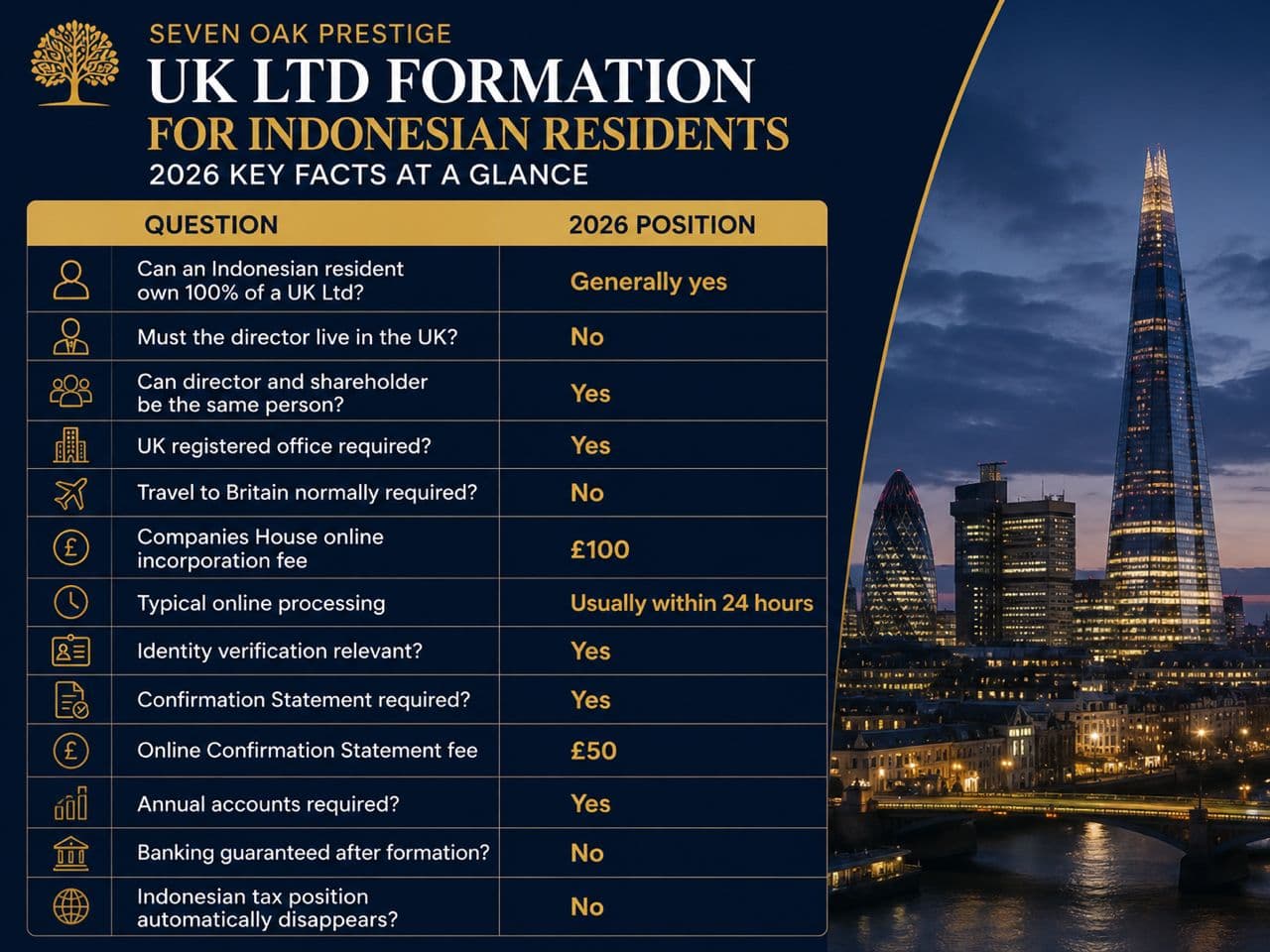
An Indonesian entrepreneur can generally establish, own and manage a UK private limited company without relocating to Britain.
A UK company must have at least one director and at least one shareholder. The same person can perform both roles, and Companies House does not require a director to live in the UK. The company does, however, need an appropriate UK registered office address.
For many Indonesian founders, however, the more important question is not:
“Can I register a UK company?”
It is:
“Does a UK Ltd actually fit the business I am building from Indonesia?”
That distinction matters.
A Jakarta-based software founder selling internationally has a different structural requirement from an Indonesian retail business selling almost entirely inside Indonesia.
Likewise, an established Indonesian PT expanding into Britain should not automatically use the same structure as an individual consultant opening their first international company.
The correct sequence is:
business model
→ customer geography
→ ownership
→ UK structure
→ Indonesia-side considerations
→ tax
→ banking
→ compliance
→ incorporation
If you first need the general non-resident formation framework, read our UK Company Formation for Non-Residents: Complete 2026 Guide.
Quick Answer: Can an Indonesian Resident Register a UK Ltd?
Yes.
An Indonesian resident can generally be:
director
- ●
shareholder
- ●
Person with Significant Control where the statutory conditions are met
of a UK private company limited by shares.
Directors do not have to reside in Britain, but the company must have a UK registered office. A company limited by shares needs at least one shareholder, and that shareholder can also be the director.
Companies House currently charges £100 for online incorporation, and GOV.UK states that an online company is usually registered within 24 hours once the application is successfully processed.
UK Ltd from Indonesia: At a Glance
1. When Does a UK Ltd Make Sense for an Indonesian Founder?
A UK company deserves serious consideration when there is a genuine international or UK-facing reason for the entity.
Typical situations include:
- SaaS and software businesses;
- digital agencies;
- consulting;
- professional services;
- international e-commerce;
- export/import activity;
- global B2B services;
- UK customer contracts;
- international partnerships;
- an existing Indonesian business entering Britain.
The strongest reason to create the company is not simply:
“A UK company looks prestigious.”
It is:
“The UK company performs a clear commercial function in the business.”
That distinction becomes increasingly important when the company later applies for banking, payment processing, tax registration or commercial contracts.
2. When a UK Ltd May Not Be the Right First Structure
A UK Ltd may create unnecessary complexity where:
- virtually all customers are in Indonesia;
- employees and operations are entirely Indonesian;
- the company principally requires Indonesian licences;
- no meaningful UK or international commercial rationale exists;
- the founder’s only objective is to obtain a bank account;
- the founder is incorporating only because a payment provider is desired.
A UK incorporation certificate does not transform an Indonesian domestic business into a genuine British operation.
The structure should reflect the commercial reality.
3. UK Ltd vs PT vs PT Perorangan
Indonesian founders should not compare structures purely by registration cost.
The better comparison is commercial purpose.
Your existing Indonesia article already correctly identifies PT and PT Perorangan as relevant domestic alternatives for Indonesian entrepreneurs.
A practical decision framework is:
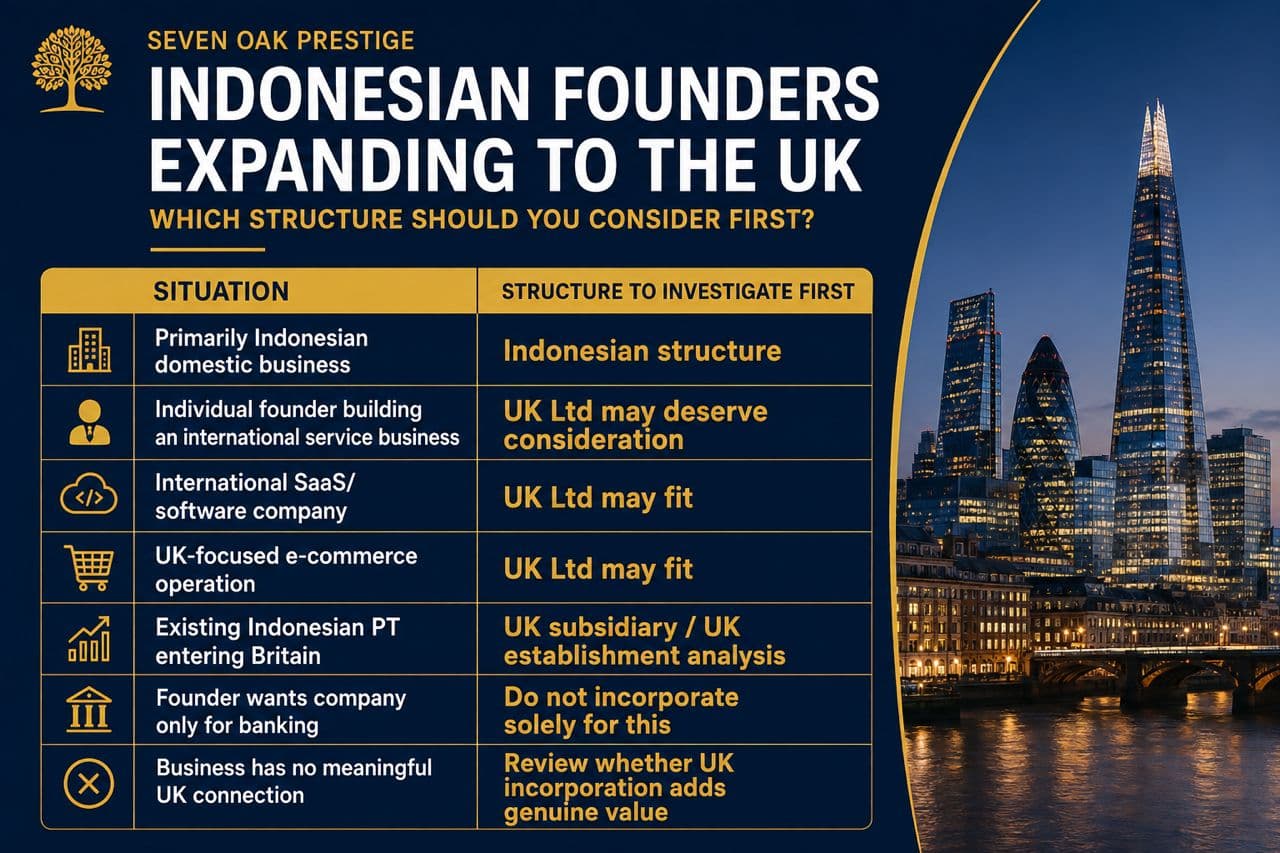
A PT and a UK Ltd are not competitors in every situation.
Sometimes they serve completely different functions.
4. Indonesian Individual → UK Ltd vs Indonesian Company → UK Subsidiary
There are two materially different Indonesia-to-UK structures.
Indonesian individual → UK Ltd
Example:
Indonesian founder
↓
100% shareholder
↓
UK Ltd
This is generally the simpler route for:
- consultants;
- freelancers;
- software founders;
- agencies;
- e-commerce entrepreneurs;
- independent professional-service businesses.
Indonesian company → UK Ltd subsidiary
Example:
Indonesian PT
↓
shareholder
↓
UK Limited Company
This can be more appropriate where an established Indonesian business wants a distinct British operation.
The UK government’s international-business guidance identifies branch, subsidiary and joint venture structures among the principal options available to overseas companies expanding into Britain.
A subsidiary can be useful where the Indonesian group wants:
- a separate UK legal entity;
- UK customer contracts;
- local employees;
- UK investment;
- a separate UK operating account;
- clearer separation between UK and Indonesian activities.
But a subsidiary creates another company, another accounting layer and potentially intercompany transactions.
It should therefore have a real commercial function.
5. How Much Does UK Company Formation from Indonesia Cost?
This should be answered directly.
The current Companies House statutory fees include:
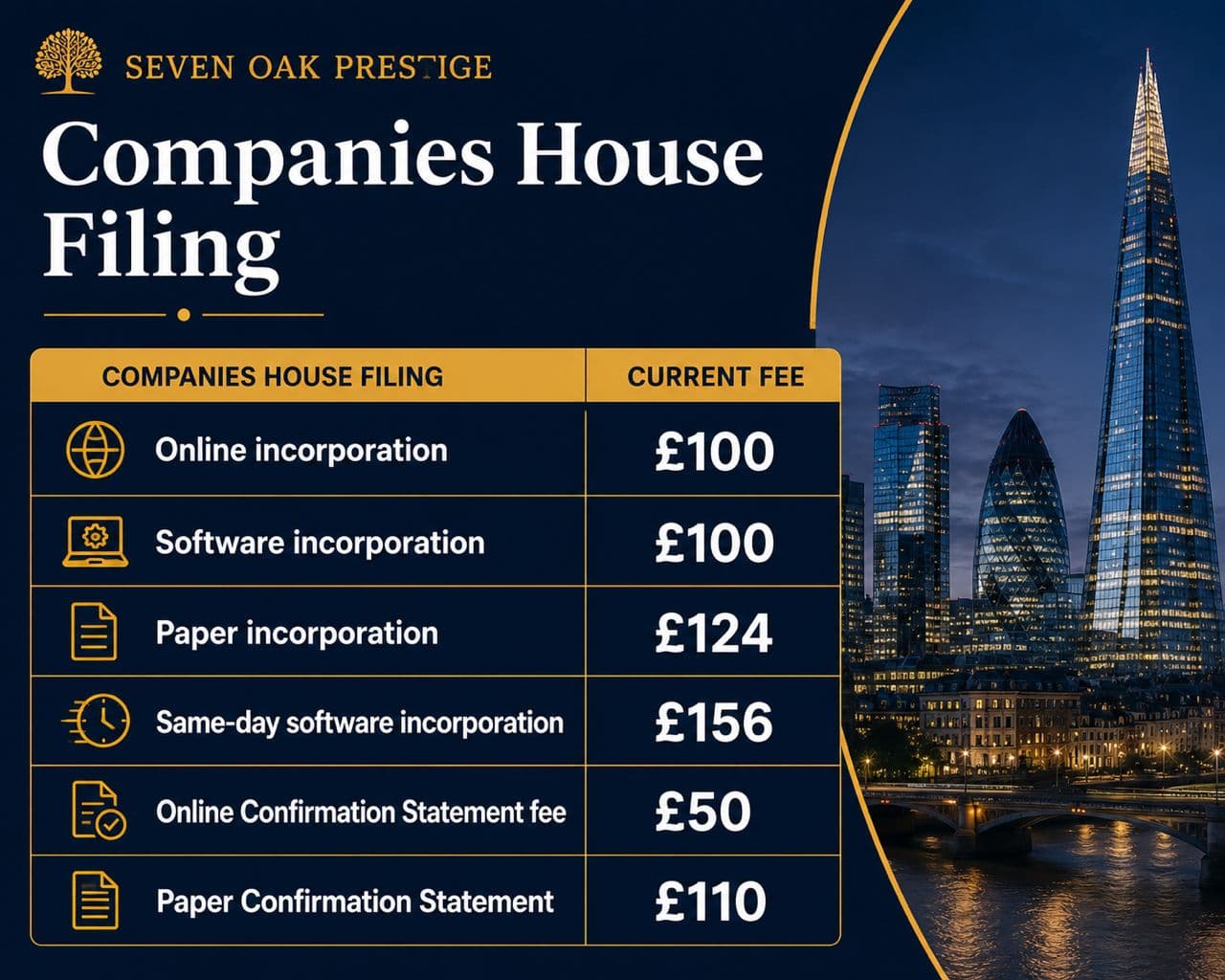
These are Companies House statutory fees, not the complete cost of operating a non-resident UK company.
An Indonesian founder may separately need:
- Registered Office;
- Director Service Address;
- identity-verification assistance;
- mail handling;
- accounting;
- tax support;
- VAT registration;
- EORI;
- compliance support.
For the complete breakdown, read How Much Does It Cost to Register a UK Company as a Non-Resident in 2026?.
The key distinction is:
£100 Companies House incorporation
is not automatically the same as:
the complete cost of establishing and maintaining an operational UK company from Indonesia.
6. What Do You Need to Register the Company?
For an ordinary company limited by shares, the key elements include:
Company name
The name must comply with Companies House rules and should be checked for availability and potential trade-mark conflicts.
Director
At least one director is required.
The director must be at least 16, but does not have to reside in Britain.
Shareholder
At least one shareholder is required.
The shareholder can also be the director.
Share structure
Decide:
- number of shares;
- nominal value;
- ownership percentage;
- whether there are multiple founders;
- rights attached to shares where relevant.
For more complex ownership, read How to Structure Shares and Directors in a UK Ltd as a Non-Resident Founder
PSC information
Companies House requires relevant People with Significant Control to be identified. Someone with more than 25% of shares or voting rights is one common example of a PSC.
Registered Office
The company requires an appropriate UK registered office.
Registered email address
Companies House also requires a registered email address.
SIC code
A SIC code identifying the company’s actual business activity is required during registration.
7. Companies House Identity Verification for Indonesian Founders
This is now an essential part of the process.
Companies House states that identity verification became a legal requirement from 18 November 2025, with relevant transition arrangements for existing directors and PSCs.
An Indonesian founder can potentially verify through GOV.UK One Login where the person has suitable identity documentation.
Companies House expressly lists a:
biometric passport from any country
as one of the supported forms of photo ID for the online route.
Alternatively, an individual can ask an Authorised Corporate Service Provider — ACSP to complete verification on their behalf.
Once relevant identity-verification requirements are satisfied, Companies House uses a personal code to connect the verified identity with company appointments and filings.
For the full framework, read Companies House Identity Verification for Non-Residents — Complete 2026 Guide
8. Step-by-Step: Registering a UK Ltd from Indonesia
Step 1 — Define why the UK company exists
Write the commercial rationale in one sentence.
For example:
“The company will provide software services to UK and international business customers.”
or:
“The UK company will operate as the British subsidiary of an existing Indonesian technology company.”
If you cannot explain why the UK entity exists, incorporation may be premature.
Step 2 — Determine the ownership
Decide whether the shareholder should be:
- you personally;
- multiple founders;
- an existing Indonesian company.
Ownership affects future:
- banking;
- tax;
- fundraising;
- governance;
- intercompany transactions.
Step 3 — Determine directors and PSCs
The filing should reflect who genuinely manages and controls the company.
Do not introduce unnecessary shareholders or directors merely to make the company appear more British.
Step 4 — Complete identity verification
Complete Companies House verification for relevant persons and obtain the necessary personal-code information.
Step 5 — Arrange the UK registered office
Every UK company needs an appropriate registered office in its jurisdiction.
The director can separately use a service address rather than making a residential address the public correspondence address. GOV.UK confirms that directors must provide a service address and that the service address is publicly available.
Step 6 — Choose the SIC code
Choose the code that genuinely represents the company’s business.
Avoid selecting a different activity solely because somebody claims it will make banking easier.
Step 7 — Confirm the share structure
For a single founder, this may be straightforward.
For multiple founders, ownership should be considered before filing rather than reconstructed later.
Step 8 — Submit the incorporation
Companies House currently charges £100 online.
An online application is usually registered within 24 hours, although actual processing can vary and registration is only complete once Companies House issues the certificate of incorporation.
Step 9 — Review the public record
After incorporation, verify:
- company name;
- number;
- directors;
- PSCs;
- registered office;
- SIC codes;
- ownership information.
Step 10 — Move into post-incorporation compliance
The company now exists legally.
That means formation should immediately be followed by:
- accounting;
- Corporation Tax;
- banking;
- VAT analysis where relevant;
- EORI where relevant;
- contracts;
- invoicing;
- company records;
- annual filing planning.
Read our What Happens After You Register a UK Company as a Non-Resident? Complete 2026 Checklist.
9. UK Corporation Tax
A UK Ltd has its own UK tax obligations.
The current Corporation Tax framework provides:
- 19% small-profits rate for qualifying profits of £50,000 or less;
- 25% main rate above £250,000;
- Marginal Relief potentially applying between those levels.
The thresholds can be affected by associated-company rules.
So statements such as:
“A UK Ltd pays 19% tax”
are incomplete.
The actual rate depends on the company’s circumstances.
10. Indonesia Can Still Matter for Tax
This is where a genuinely Indonesia-specific guide should outperform generic formation pages.
Registering a company with Companies House does not automatically mean the business has no Indonesian tax considerations.
Indonesia’s Directorate General of Taxes has rules that look at the actual location of management and control when determining corporate tax residence. Its current published framework refers to strategic investment and operational decisions being made in Indonesia as relevant to a company’s center of management and control.
That means an Indonesian resident should not assume:
UK incorporation = only UK tax.
If the company is substantively managed from Indonesia, the cross-border analysis can become more complex.
This is exactly the sort of issue that deserves qualified Indonesian and UK tax advice where material.
11. UK–Indonesia Double Taxation Agreement
The UK and Indonesia have a Double Taxation Agreement that has also been modified by the Multilateral Instrument.
HMRC updated the published synthesised treaty text in May 2026.
The treaty covers matters including:
- tax residence;
- permanent establishment;
- business profits;
- associated enterprises;
- dividends;
- interest;
- royalties;
- capital gains;
- elimination of double taxation.
The treaty is designed to coordinate taxing rights and reduce qualifying double taxation.
It does not mean:
“The company will only ever pay tax in one country.”
The actual result depends on the facts.
12. Management and Control: Why Indonesian Founders Should Care
Consider an Indonesian founder who:
- lives permanently in Jakarta;
- operates the company from Jakarta;
- negotiates its major contracts there;
- makes strategic decisions there;
- controls finance from Indonesia.
The company is still legally incorporated in Britain.
But those facts can be relevant to the cross-border tax analysis.
The Indonesian tax authority’s published rules expressly refer to strategic decisions and management/control in Indonesia when assessing corporate residence.
The UK–Indonesia treaty also contains residence and permanent-establishment provisions for cross-border businesses.
Therefore:
place of incorporation
and
place where the business is actually managed
should not be treated as the same question.
13. Permanent Establishment
A UK company can also create tax consequences outside the UK if it carries on sufficient activities in another jurisdiction.
The UK–Indonesia treaty contains a dedicated permanent-establishment framework and rules for attributing business profits where an enterprise operates through a permanent establishment in the other country.
Whether a permanent establishment exists depends on the real facts.
It should not be assumed simply from the director’s residence, nor ignored simply because the company certificate says England and Wales.
14. Banking: Keep Formation and Banking Separate
A UK company can potentially apply for business banking and fintech services.
But incorporation does not guarantee approval.
This page should therefore not duplicate your dedicated banking guide.
The formation article only needs to establish the principle:
Companies House registration and financial-provider onboarding are separate decisions.
Providers can assess:
- founder residence;
- beneficial ownership;
- business activity;
- website;
- operating address;
- customers;
- suppliers;
- source of funds;
- source of wealth;
- expected transaction volumes;
- transaction countries.
For the complete Indonesia-specific banking analysis, read How to Open a UK Business Bank Account from Indonesia — Complete 2026 Guide.
That is where banking intent should live.
15. Do Not Form a UK Ltd Only for a Bank Account, Stripe, Wise or PayPal
This deserves its own section because it differentiates Seven Oak from aggressive formation marketing.
A UK Ltd does not guarantee acceptance by:
- a bank;
- EMI;
- Wise;
- Revolut;
- Stripe;
- PayPal;
- another payment provider.
Each provider makes an independent risk and eligibility decision.
The company should be built around the actual business, not around an assumption that incorporation automatically opens access to a specific provider.
This is also where some competitor pages are weaker: they package incorporation, banking and “ready to trade” into a single commercial promise, whereas in practice company registration and provider approval are separate processes.
16. UK Ltd for Indonesian SaaS and Technology Founders
A UK Ltd can be particularly relevant to Indonesian SaaS, software, AI and technology founders where:
- customers are international;
- contracts are denominated in GBP, USD or EUR;
- the business plans UK market entry;
- intellectual property is to be held by the UK entity;
- British or international investors may be approached;
- a separate international operating vehicle is commercially useful.
But founders should decide:
- who owns the software;
- which company contracts with customers;
- where developers work;
- how the company is funded;
- where decisions are made;
- whether an Indonesian company already owns relevant IP.
Those questions become important later.
17. UK Ltd for Indonesian Agencies and Consultants
A UK Ltd may work well for:
- digital agencies;
- consultants;
- designers;
- software developers;
- marketing agencies;
- B2B service providers.
The commercial benefit is clearest where the company is genuinely used for international contracting.
A London registered office should not be used to suggest that work is physically performed in the UK when the business actually operates elsewhere.
Corporate presentation and operational reality should remain consistent.
18. UK Ltd for Indonesian E-Commerce Businesses
A UK Ltd can potentially support:
- Shopify;
- Amazon;
- Amazon FBA;
- eBay;
- direct-to-consumer brands;
- international wholesale;
- subscription commerce.
But a UK e-commerce business is not simply:
UK Ltd + website + Stripe.
You also need to consider:
- suppliers;
- inventory;
- fulfilment;
- VAT;
- customs;
- EORI;
- product compliance;
- consumer law;
- payment providers;
- returns;
- banking.
For deeper e-commerce analysis, read UK E-Commerce Company for Non-Residents: Complete 2026 Guide.
19. Do You Need an EORI Number?
Where a UK company imports goods into England, Wales or Scotland, GOV.UK states that it needs an EORI number beginning with GB.
This is particularly important for Indonesian businesses importing:
- clothing;
- electronics;
- furniture;
- consumer products;
- manufactured goods;
- other physical inventory
into Britain.
A company selling only digital services will have a very different customs profile.
20. VAT
UK VAT does not automatically apply simply because the company has been incorporated.
VAT treatment depends on matters such as:
- what is sold;
- where customers are located;
- whether goods are stored in Britain;
- whether the business is UK-established for VAT purposes;
- marketplace arrangements;
- turnover;
- import structure.
An Indonesian e-commerce founder holding inventory in Britain can therefore have a significantly different VAT profile from an Indonesian consultant providing digital B2B services.
Formation and VAT should be analysed separately.
21. What Happens After Incorporation?
A UK company does not become “maintenance-free” because its director lives overseas.
Annual accounts
GOV.UK states that a private company must prepare statutory annual accounts and a Company Tax Return.
For a normal private company:
- first Companies House accounts are generally due 21 months after incorporation;
- subsequent annual accounts are generally due 9 months after the financial year end;
- Corporation Tax is normally payable 9 months and 1 day after the Corporation Tax accounting period ends;
- the Company Tax Return is normally due 12 months after that accounting period ends.
Confirmation Statement
A company must review its Companies House information and submit at least one Confirmation Statement every 12 months.
The current online fee is £50 for the first statement within the relevant annual payment period.
Corporation Tax activation
HMRC states that an active company within Corporation Tax should notify HMRC within three months of starting its tax accounting period.
22. Indonesia → UK Decision Matrix
Founder situation
Structure to investigate
Individual Indonesian consultant with international clients
UK Ltd may fit
Indonesian software/SaaS founder
UK Ltd may fit
Indonesian e-commerce founder targeting UK
UK Ltd + VAT/EORI analysis
Business operates only domestically in Indonesia
Indonesian structure may be more natural
Existing PT entering Britain
UK subsidiary / establishment analysis
Indonesian business wants a separate UK legal entity
UK subsidiary
Founder wants only a UK bank account
Do not form solely for this
Founder wants only Stripe/PayPal
Do not form solely for this
Business substantially managed in Indonesia
Cross-border tax review
Indonesian parent and UK subsidiary transact
Intercompany/tax analysis
23. Pre-Incorporation Checklist
Before registering the company, answer:
Business
What does the company actually sell?
Customers
Indonesia, UK, EU, US or global?
Ownership
Individual founder or Indonesian corporate parent?
Management
Where are strategic decisions genuinely made?
Operations
Where are employees, contractors and inventory?
UK purpose
Why does the business need a UK entity?
Banking
Which providers support the actual founder profile and activity?
Tax
Have UK and Indonesian implications been considered?
E-commerce
Will goods be imported or stored in Britain?
Long-term structure
Could the company later have investors, employees or subsidiaries?
If these answers are unclear, it can be better to resolve them before incorporation.
Frequently Asked Questions
Can an Indonesian citizen own 100% of a UK Ltd?
Generally, yes. UK company law does not require a UK-resident shareholder simply because the company is owned by someone living overseas.
Do I need a British director?
No. GOV.UK states that company directors do not have to live in the UK, although the company needs a UK registered office.
Can I form the company remotely?
Generally yes.
Companies House provides online incorporation, and many non-resident formations can be completed without travel where the required documentation and identity verification are satisfied.
How much does UK company registration cost?
The current standard online Companies House incorporation fee is £100.
How long does incorporation take?
Companies House states that online applications are usually registered within 24 hours.
That is not a guaranteed service-level promise for every application.
Do Indonesian directors need identity verification?
Companies House identity-verification requirements now apply to directors and PSCs according to the statutory implementation timetable.
Can I use an Indonesian passport?
Companies House states that a biometric passport from any country can be used through the relevant GOV.UK One Login route where the requirements are met.
Can my Indonesian PT own the UK company?
A UK company can have a corporate shareholder.
For an existing Indonesian company entering Britain, a subsidiary may therefore deserve consideration.
Is a UK Ltd better than a PT?
Not universally.
A PT may be more natural for a domestic Indonesian business.
A UK Ltd may be more useful where the genuine commercial objective is international or UK-facing.
Will my UK Ltd pay tax only in Britain?
Not necessarily.
UK incorporation creates UK tax obligations, but actual management and Indonesian activities can also matter.
Indonesia’s tax authority considers management and control factors in corporate-residence analysis, and the UK–Indonesia treaty coordinates certain cross-border tax issues.
Does a UK company guarantee business banking?
No.
Banking approval is separate from incorporation.
For the detailed analysis, read How to Open a UK Business Bank Account from Indonesia.
Does a UK company guarantee Stripe, Wise, Revolut or PayPal?
No.
Each provider has independent eligibility, KYC and risk rules.
Does a UK Ltd automatically need VAT?
No.
VAT depends on the actual supplies, customers, establishment and operating model.
Do I need EORI?
If the company imports goods into England, Wales or Scotland, a GB EORI is generally required.
How Seven Oak Prestige Helps Indonesian Founders
Seven Oak Prestige supports overseas entrepreneurs with the UK side of company establishment and operational readiness.
Support can include:
- UK Limited Company formation;
- ownership and share-structure preparation;
- Companies House identity-verification support;
- Registered Office;
- Director Service Address;
- Virtual Business Address;
- VAT registration;
- EORI registration;
- banking-readiness preparation;
- post-incorporation compliance planning.
Our objective is not simply to register as many UK companies as possible.
The objective is to help determine whether the UK company has a genuine role in the founder’s international structure and, where it does, establish the UK side properly.
Start My UK Company
For Indonesian founders who have already determined that a UK Ltd fits their business model and want assistance completing the UK setup.
Start My UK Company
Review My Indonesia–UK Setup
For founders or established Indonesian businesses deciding between:
- individual → UK Ltd;
- Indonesian PT → UK subsidiary;
- UK Ltd vs Indonesian structure;
- international expansion vs domestic operating structure.
Review My Indonesia–UK Setup
Final Takeaway
An Indonesian resident can generally establish, own and direct a UK Limited Company without relocating to Britain.
But registering the company should not be the first strategic decision.
A stronger process is:
Indonesian founder or business
↓
commercial objective
↓
customer geography
↓
individual ownership vs Indonesian corporate ownership
↓
UK Ltd vs Indonesian structure
↓
Companies House requirements
↓
identity verification
↓
tax
↓
banking
↓
VAT / EORI where relevant
↓
annual compliance
and only then:
register the company.
The strongest UK company is not simply the one that was incorporated fastest.
It is the one whose ownership, activity, tax position, banking profile and operating model remain coherent after incorporation.
About the Author
Isaac Jackson
Founder — Seven Oak Prestige Ltd
Isaac Jackson has 3+ years of hands-on experience supporting international entrepreneurs with UK company formation, Companies House compliance and cross-border business-establishment matters.
Seven Oak Prestige has supported close to 100 UK company formation and establishment cases, including overseas founders requiring assistance with company structure, Companies House identity verification, UK address infrastructure, banking readiness and post-incorporation planning.
For Indonesia-related content, the editorial emphasis is on distinguishing simple UK incorporation from a commercially coherent Indonesia–UK structure.
Last reviewed: 31 August 2026
Editorial Methodology
This guide is prepared using four complementary layers of review.
Primary regulatory sources. We review current Companies House, HMRC and GOV.UK guidance covering company incorporation, directors and shareholders, identity verification, filing fees, annual accounts, Confirmation Statements, Corporation Tax and EORI requirements. Indonesian tax considerations are checked against published material from Indonesia’s Directorate General of Taxes, while bilateral tax matters are checked against the current UK–Indonesia Double Taxation Agreement and its MLI-modified text.
Practical non-resident experience. The guide incorporates recurring real-world issues around ownership, Companies House verification, address consistency, activity descriptions, KYC readiness and post-incorporation obligations.
Editorial Disclaimer
This article provides general information about UK company formation for people and businesses connected with Indonesia.
It does not constitute personalized:
- UK legal advice;
- Indonesian legal advice;
- UK or Indonesian tax advice;
- accounting advice;
- banking advice;
- regulated financial advice;
- immigration advice.
Corporate residence, permanent-establishment exposure, Indonesian tax treatment, treaty relief, VAT and other cross-border outcomes depend on the actual facts.
Seven Oak Prestige supports the UK company-establishment and operational-readiness side of international structures.
Where Indonesian tax, legal or regulatory issues are material, advice should also be obtained from appropriately qualified Indonesian professionals.
Primary Sources Reviewed
For maximum E-E-A-T, I would keep this section visible at the very bottom of the article, after the disclaimer.
Companies House / GOV.UK — Set up a private limited company
Covers directors, shareholders, PSCs, Registered Office requirements and registration. View official Companies House guidance
Companies House — Register your company
Confirms the current £100 online incorporation fee and that online companies are usually registered within 24 hours. View official incorporation guidance
Companies House — Identity Verification
Explains the mandatory identity-verification framework, GOV.UK One Login and ACSP verification. View identity-verification guidance
Companies House — Current Filing Fees
Lists the current incorporation and Confirmation Statement fees. View Companies House fees
HMRC — Accounts and Tax Returns for Private Companies
Sets out annual accounts, Corporation Tax payment and Company Tax Return deadlines. View HMRC filing guidance
HMRC — Corporation Tax Rates
Explains the 19% small-profits rate, 25% main rate and Marginal Relief framework. View Corporation Tax rates
GOV.UK — Importing Goods into the UK
Confirms the GB EORI requirement for relevant imports into England, Wales and Scotland. View UK import and EORI guidance
HMRC — UK–Indonesia Double Taxation Agreement
Current treaty material, including the MLI-modified synthesized version covering residence, permanent establishment, business profits and double-tax relief. View the UK–Indonesia tax treaty
Directorate General of Taxes — Indonesia
Published Indonesian tax rules addressing corporate residence and management/control considerations. View Indonesian tax authority guidance