
UK Business Bank Account Rejected? What Non-Resident Founders Should Do Next

UK Business Bank Account Application Rejected? What Non-Resident Founders Should Do Next
A rejected UK business banking application does not mean your UK company is invalid or that every other provider will reject you.
It does mean you should avoid submitting the same application elsewhere without first understanding what may have gone wrong.
For a non-resident founder, the strongest next step is usually:
Review → correct → document → check provider fit → apply selectively.
Different banks, Electronic Money Institutions (EMIs) and payment providers have different eligibility criteria, geographic policies, supported activities and risk appetites.
A Companies House incorporation therefore does not guarantee banking approval — and one provider’s decision does not automatically determine another provider’s decision.
This guide focuses specifically on what to do after an application has already been declined.
If you are trying to understand the underlying causes first, read our separate guide to 7 Reasons UK Business Bank Account Applications Are Unsuccessful.
Quick Answer: What Should You Do After a UK Business Banking Rejection?
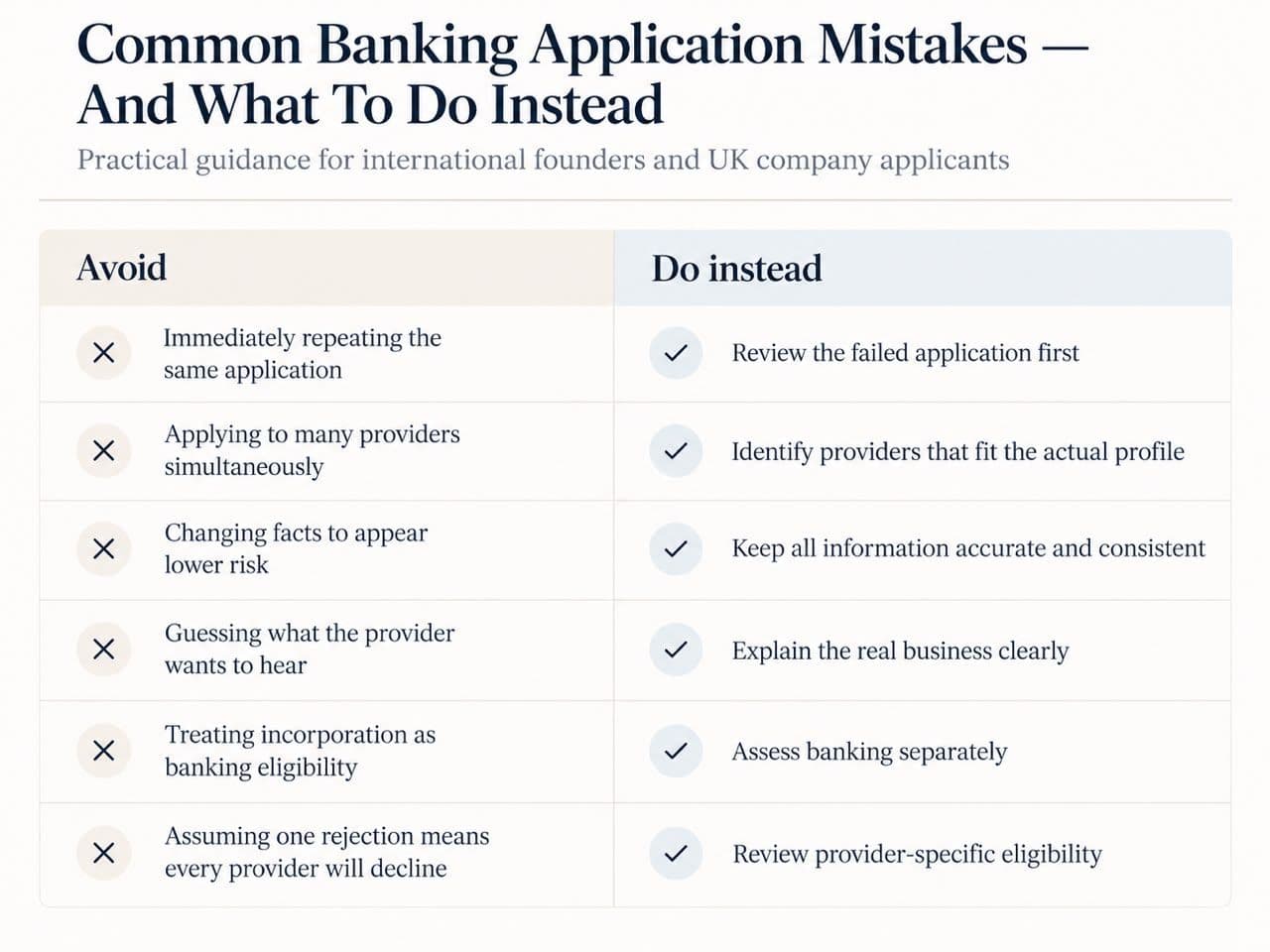
Do not immediately apply to several more providers.
First establish whether the problem was:
- incorrect or inconsistent information;
- incomplete KYC or business documentation;
- unclear business activity;
- unsupported country of residence;
- transaction geography;
- ownership complexity;
- source-of-funds concerns;
- the provider simply not supporting your business profile.
Then decide whether the issue can be corrected before another application or whether a different provider is more appropriate.
Already Had a UK Business Banking Application Declined?
Seven Oak Prestige can review the company profile, documentation, business model and expected transactions before you decide where to apply next.
Discuss My Banking Readiness →
Banking approval always remains with the relevant bank, EMI or payment provider.
1. First, Understand What Was Actually Rejected
There is an important distinction between:
an application being declined
and
an existing account being closed.
This article concerns primarily the first situation: you applied for a UK business banking or payment account and the provider decided not to onboard the company.
That is different from “debanking” or termination of an existing payment account.
If you have never been onboarded, focus first on the application, provider eligibility and information submitted rather than assuming that account-closure rules apply to your case.
2. Ask the Provider Whether It Can Explain the Decision
Start with the provider itself.
Some institutions may provide a general explanation. Others may provide little detail because of internal risk policies, financial-crime controls or other regulatory considerations.
You can still ask whether the decline relates generally to:
- eligibility;
- documentation;
- residence;
- business activity;
- verification;
- ownership;
- expected account usage.
Do not assume that a limited explanation means your company has done something wrong.
Financial institutions make independent onboarding decisions according to their own policies and regulatory obligations.
Where you believe information was factually incorrect or the application was mishandled, you may also consider the provider’s formal complaints procedure. Whether a complaint can subsequently be taken to the Financial Ombudsman Service depends on the circumstances and eligibility of the complainant.
3. Was the Problem Fixable — or Was the Provider Simply the Wrong Fit?
This is the most important question before applying again.
Some issues can potentially be corrected.
Others cannot.
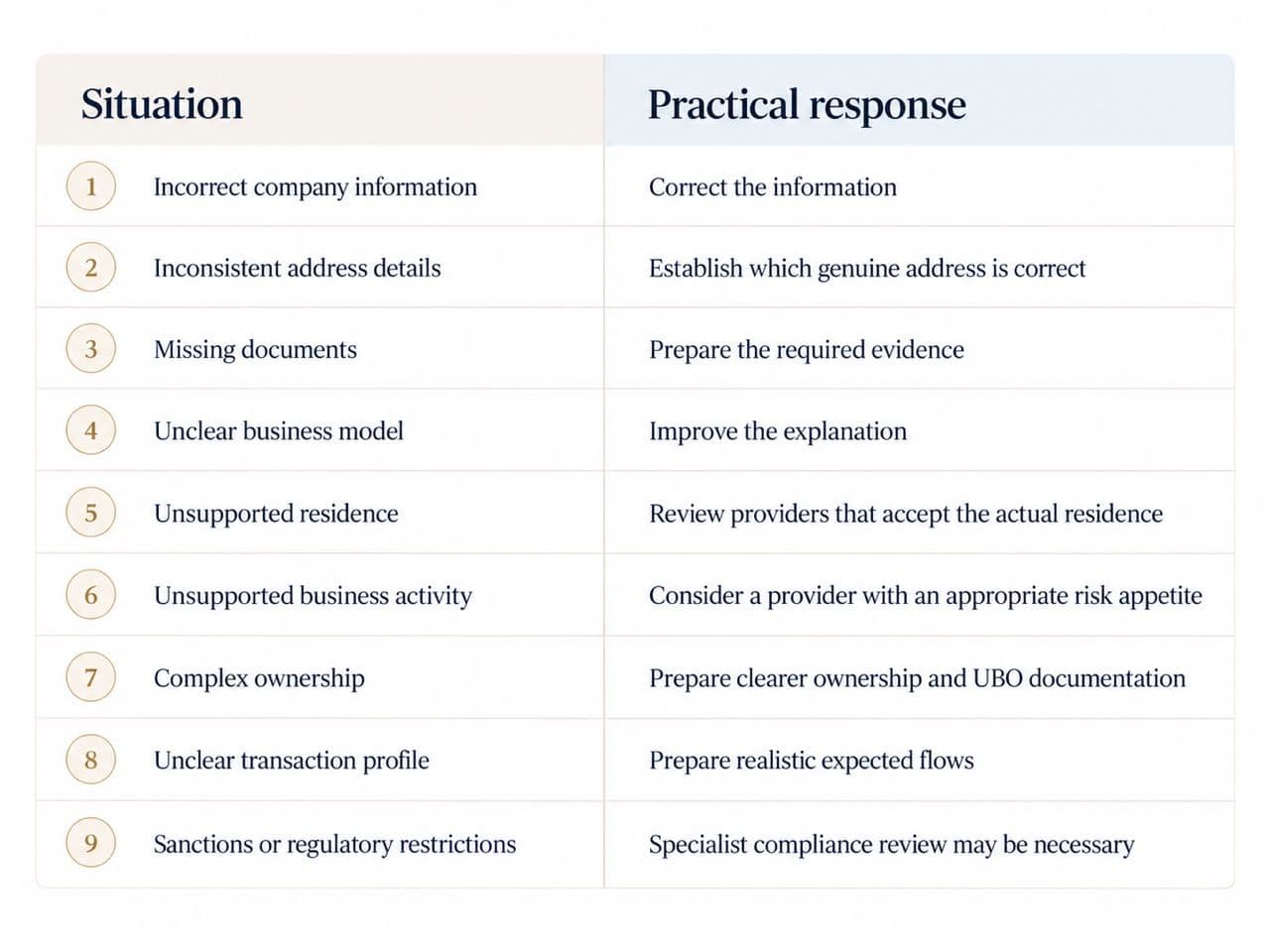
The objective is not to make the company look artificially lower risk.
It is to make the real business easier to understand and to identify a provider whose eligibility framework is more compatible with it.
For the broader provider landscape, read our UK Business Banking for Non-Residents: Banks, Fintechs & Eligibility Explained.
4. Review the Declined Application Before Attempt Two
A proper post-rejection review should examine at least five areas.
A. Founder and Residence Information
Check:
- director name;
- shareholder and UBO information;
- nationality;
- genuine residential address;
- proof of address;
- identity documents;
- country from which verification was completed.
Do not state that you live in the UK simply because your company has a UK Registered Office or Virtual Business Address.
A company’s Registered Office and a director’s residential address perform completely different functions.
For a detailed explanation, see UK Registered Office vs Director Service Address for Non-Residents.
B. Business Activity
Could an external reviewer understand in less than a minute:
- what the company does;
- what it sells;
- who pays it;
- where customers are located;
- how revenue is generated?
“Consulting”, “e-commerce” or “online services” may be too broad on their own.
But your banking description does not need to repeat a SIC code word for word.
The important issue is commercial coherence.
Your:
- Companies House record;
- SIC codes;
- website;
- banking application;
- invoices;
- contracts;
should tell the same truthful business story without material contradictions.
If the SIC code itself no longer reflects the company’s real activity, review it before submitting another provider application. Our guide to UK SIC codes for non-resident companies explains how to choose, check and update the classification while keeping it distinct from the more detailed business description used during KYC or provider onboarding.
For the detailed rejection factors, use our separate 7 Reasons UK Business Bank Account Applications Are Unsuccessful.
C. Ownership and Control
International structures can require additional explanation.
Be ready to show clearly:
- shareholders;
- percentage ownership;
- directors;
- Persons with Significant Control where applicable;
- corporate shareholders;
- parent companies;
- ultimate beneficial owners.
A legitimate international structure is not automatically a problem.
The issue is whether the provider can understand and verify who ultimately owns and controls the business.
D. Supporting Evidence
Depending on the business and provider, useful supporting material may include:
- Certificate of Incorporation;
- identity documents;
- genuine proof of residential address;
- ownership information;
- website;
- business plan;
- customer contracts;
- supplier agreements;
- invoices;
- marketplace information;
- source-of-funds evidence;
- evidence supporting expected activity.
Not every provider asks for every document.
The objective is to have a coherent evidence file available rather than constructing the explanation only after questions arise.
E. Expected Transactions
Be able to explain:
- expected monthly turnover;
- average transaction value;
- currencies;
- customer countries;
- supplier countries;
- source of initial funding;
- incoming payment types;
- major outgoing payments.
Projected figures should be genuine and commercially explainable.
A newly incorporated company can legitimately expect significant activity, but the provider may ask what supports those expectations.
5. Should You Reapply to the Same Provider?
Possibly — but not automatically.
First check whether the provider permits a new application and whether anything material has changed.
Reapplying may make sense where, for example:
- an incorrect document was submitted;
- address information was wrong;
- requested evidence was unavailable but is now available;
- the business was inadequately explained;
- a genuine verification problem has been resolved.
A repeat application is less useful where the provider simply does not support:
- your country of residence;
- your business activity;
- your ownership structure;
- your required account functionality;
- the relevant transaction geography.
In those circumstances, improving the wording does not change the underlying eligibility problem.
6. Should You Apply to a Different Provider?
Sometimes this is the more rational route.
A bank, EMI and payment provider can each have a different:
- country policy;
- prohibited-activity policy;
- onboarding model;
- customer profile;
- compliance framework;
- appetite for international ownership;
- required UK presence.
A rejection from Provider A therefore does not prove that Provider B will reach the same conclusion.
But that does not mean you should submit applications randomly.
The better sequence is:
Founder residence
↓
Business activity
↓
Ownership
↓
Transaction geography
↓
Required banking functionality
↓
Provider eligibility
↓
Application
Our UK Business Banking for Non-Residents Guide explains the broader differences between banks, fintechs and EMIs for international founders.
7. Do Not Change Material Facts to Obtain Approval
This deserves its own section.
After a rejection, some founders are tempted to change the next application to appear easier to onboard.
Do not claim:
- UK residence if you genuinely live overseas;
- a UK operating office when you only have a Registered Office;
- employees who do not exist;
- customers you do not have;
- transaction volumes that cannot reasonably be explained;
- a lower-risk activity that is different from the real business;
- a different source of funds simply because it appears easier to approve.
Banking readiness is about making a legitimate business clearer and better documented.
It is not about creating a fictional version of the business.
8. What If You Come From a Higher-Risk Jurisdiction?
Country risk requires careful terminology.
Nationality, residence, transaction geography, sanctions exposure and a provider’s internal risk appetite are different factors.
A provider may conduct additional due diligence because of:
- residence;
- source or destination of funds;
- customers or suppliers;
- sanctions exposure;
- ownership;
- business sector;
- wider geographic risk.
That does not mean every applicant from a particular nationality receives the same outcome.
It also does not mean Companies House incorporation and banking eligibility are the same.
A founder may potentially be legally eligible to own a UK company while facing substantially narrower banking options.
For the corporate-formation side of this distinction, read our UK Company Formation for Higher-Risk Countries.
9. Use a Banking-Readiness File Before the Next Application
Before choosing the next provider, create one coherent file.
Founder
- passport or accepted identity document;
- genuine residential address evidence;
- clear ownership information;
- source-of-funds information where relevant.
Company
- Certificate of Incorporation;
- Companies House information;
- ownership structure;
- business activities;
- relevant company addresses.
Commercial
- website;
- contracts;
- invoices where available;
- customer profile;
- supplier profile;
- business plan where useful.
Transactions
- currencies;
- expected turnover;
- transaction sizes;
- customer countries;
- supplier countries;
- source of initial capital.
Then check for contradictions.
Seven Oak’s UK Business Banking Readiness Assessment provides a structured framework for reviewing these areas before another application.
10. How Seven Oak Prestige Supports Founders After a Banking Rejection
Seven Oak Prestige supports international founders with banking readiness and application preparation.
Where a UK company has already received a decline, our work can include reviewing:
- the existing company profile;
- founder and ownership information;
- business-activity explanation;
- documentation readiness;
- expected transaction profile;
- website and public-business consistency;
- geographic considerations;
- potential provider fit.
Where appropriate, we can then help the founder prepare for a more targeted subsequent application.
We do not control the provider’s decision.
We cannot guarantee acceptance by a:
- bank;
- EMI;
- fintech;
- payment institution;
- Wise;
- Revolut;
- Airwallex;
- Payoneer;
- Stripe;
- or any other financial provider.
Each provider conducts its own independent onboarding, KYC, KYB, compliance and risk assessment.
Already Been Declined?
Instead of immediately submitting another application, review the company and banking-readiness profile first.
11. Frequently Asked Questions
Does a rejected business bank account application appear on Companies House?
No.
Companies House maintains the UK’s company register. A provider’s decision not to onboard your company does not become part of the company’s public Companies House record.
Banking and company incorporation are separate processes.
Can I apply to another bank after being rejected?
Potentially, yes.
Different providers have different eligibility and risk frameworks.
However, if the first application contained an error, inconsistency or unresolved documentation problem, address that issue before applying elsewhere.
Can I apply to the same provider again?
It depends on the provider and the reason for the first decision.
Check its current policy before making another application.
A repeat application may be appropriate where a genuine, correctable issue has been resolved, but there is little value in trying to overcome an eligibility restriction by simply changing the wording.
How long should I wait before applying again?
There is no universal waiting period applicable to every bank, EMI or fintech.
The more important question is whether the underlying application is now ready and whether the next provider is appropriate.
Do not choose an arbitrary waiting period instead of fixing a genuine issue.
Will a bank tell me why my business account application was rejected?
Sometimes only limited information is provided.
You can ask the provider for clarification, but legal, regulatory or internal risk considerations may limit what it can disclose.
Can I complain about a rejected business account application?
Potentially.
Start with the provider’s complaints process where you believe there has been an error or unfair handling.
Financial Ombudsman Service eligibility depends on the applicant and circumstances, so not every international company or applicant will necessarily fall within its jurisdiction.
A complaint also does not create an automatic entitlement to a business account.
Does a UK Limited Company guarantee a UK business bank account?
No.
Companies House incorporation establishes the company.
Banks and payment providers conduct separate onboarding assessments covering matters such as identity, residence, ownership, business activity, transaction profile and financial-crime risk.
Is an EMI the same as a bank?
No.
Electronic Money Institutions and banks operate under different regulatory frameworks and can offer different protections and services.
This distinction can be particularly important for international founders comparing UK business-account options.
Read our UK Business Banking for Non-Residents Guide before selecting a provider.
Does being a non-resident automatically cause a rejection?
No.
However, residence can form part of a provider’s eligibility and risk assessment.
Some providers support directors living in particular overseas jurisdictions; others require different geographic connections or do not support certain profiles.
Always check the provider’s current eligibility rules before applying.
Should I apply to several providers at the same time?
Usually, a more controlled approach is preferable for a non-resident founder.
Determine what the company actually needs, assess provider eligibility, prepare the evidence and then apply selectively rather than submitting the same profile indiscriminately.
12. Your Next Banking Application Should Be Deliberate
A banking rejection should change the quality of the next decision, not simply increase the number of applications you submit.
The strongest sequence is:
Understand what happened
↓
Correct genuine problems
↓
Prepare the evidence
↓
Check provider eligibility
↓
Choose the appropriate route
↓
Apply accurately and consistently
A UK company does not need to look artificially simple.
It needs to be truthful, coherent and understandable.
Review Your UK Banking Readiness
If your UK Limited Company has already received a banking or payment-provider decline, Seven Oak Prestige can help you review the structure and prepare for the next stage.
Provider approval remains independent and cannot be guaranteed.
13. About the Author
Isaac Jackson — Founder & Managing Director, Seven Oak Prestige Ltd
Isaac Jackson has more than three years of hands-on experience supporting international founders with UK company formation, Companies House processes, address solutions, compliance preparation and banking readiness.
His work includes helping international entrepreneurs understand how company structure, business activities, KYC documentation, residence, transaction profiles and provider eligibility can affect the banking-readiness process.
14. Editorial Methodology
Last reviewed: 8 September 2026
This guide was prepared following a review of current UK business-banking search results, Seven Oak Prestige’s existing non-resident banking content and relevant UK regulatory material, including information from the Financial Conduct Authority, Financial Ombudsman Service and UK payment-services framework.
The article is specifically designed to distinguish:
- Companies House incorporation from banking approval;
- an application rejection from closure of an existing account;
- correctable documentation issues from provider-eligibility restrictions;
- Seven Oak Prestige’s banking-readiness support from the independent decision of a financial institution.
Provider eligibility and onboarding policies can change, so current requirements should always be checked before submitting an application.
15. Important Disclaimer
This guide provides general information for international founders and does not constitute legal, tax, financial, investment or regulated banking advice.
Seven Oak Prestige Ltd provides company-formation, corporate-support, compliance-preparation and banking-readiness assistance. Seven Oak Prestige is not a bank and does not make onboarding decisions on behalf of banks, Electronic Money Institutions, payment institutions or fintech providers.
A UK company registration does not guarantee access to banking or payment services.
Any application remains subject to the chosen provider’s current eligibility requirements, KYC/KYB procedures, AML controls, sanctions screening, internal risk policies and independent approval.
16. Related Guides
- 7 Reasons UK Business Bank Account Applications Are Unsuccessful
- UK Business Banking for Non-Residents: Banks, Fintechs & Eligibility Explained
- UK Business Banking Readiness Assessment
- UK Company Formation for Non-Residents: Complete 2026 Guide
- UK Company Formation for Higher-Risk Countries
- Registered Office vs Director Service Address UK