
UK Limited Company Accounting Records: Overseas Guide
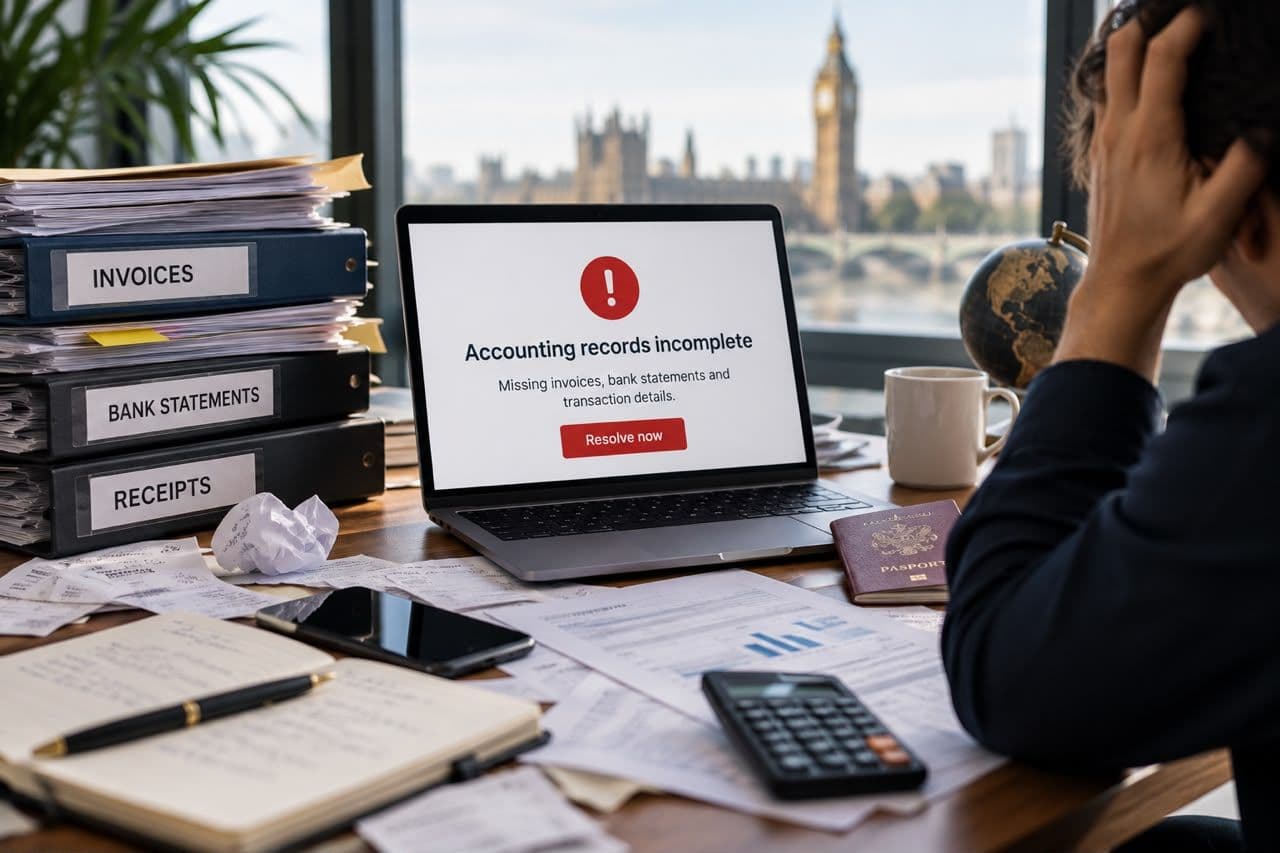
How to Keep Accounting Records for a UK Limited Company When Living Abroad
A UK limited company must keep adequate accounting records even when its director lives overseas. These records must explain the company’s financial transactions, show its assets and liabilities, and provide the information needed to prepare accurate annual accounts and Corporation Tax returns.
For non-resident directors, the challenge is often practical.
Customers may pay through several platforms. Suppliers may operate in different countries. Invoices may be issued in US dollars, euros or other currencies, while the company’s accounts are prepared under UK accounting requirements.
The company still needs a reliable way to bring that information together.
This guide explains which accounting records a UK limited company must keep, how to organise bookkeeping remotely, how long records must be retained and the additional rules that apply when accounting records are kept outside the United Kingdom.
Quick Answer: What Accounting Records Must a UK Limited Company Keep?
A UK limited company must maintain records of its income, expenditure, assets, liabilities and relevant supporting documents.
Three important rules apply.
1. Adequate accounting records are mandatory.
Under section 386 of the Companies Act 2006, records must explain the company’s transactions and disclose its financial position with reasonable accuracy.
2. Records must be retained for the required period.
A private limited company must generally preserve its statutory accounting records for at least three years from the date they were made.
For Corporation Tax purposes, relevant records generally need to be kept for six years from the end of the accounting period to which they relate, or longer in certain circumstances.
3. Additional requirements apply when records are kept outside the UK.
Section 388 requires accounts and returns relating to business recorded outside the UK to be sent to and kept in the UK. These must disclose the business’s financial position with reasonable accuracy at intervals of no more than six months.
Living abroad does not remove these obligations.
What Accounting Records Must a UK Limited Company Keep?
Every UK limited company must keep accounting records sufficient to show and explain its transactions and disclose its financial position with reasonable accuracy.
The records must also enable directors to prepare accounts that comply with the applicable legal requirements.
In practical terms, the company needs information showing:
- Money received and spent.
- Assets owned by the company.
- Liabilities and outstanding debts.
- Amounts owed by customers.
- Amounts owed to suppliers.
- Relevant sales and purchase transactions.
- Supporting invoices, receipts, statements and correspondence.
- Stock and inventory information, where applicable.
The precise records required depend on the nature of the business.
For example, a software consultancy may mainly need customer invoices, contractor bills, subscription expenses and payment statements.
An e-commerce company may also need marketplace reports, stock records, refunds, fulfilment charges and evidence of goods purchased and sold.
The objective is not to collect paperwork unnecessarily. It is to maintain reliable evidence of the company’s financial activity.
Official guidance: Companies House — Preparing and Filing Company Accounts.
Does Living Abroad Change UK Company Record-Keeping Requirements?
No. A UK company’s accounting obligations do not disappear because its director or shareholder lives outside the United Kingdom.
Consider a director living in India who operates a UK software company.
The company invoices customers in the United States, receives payments in US dollars and pays contractors in several countries.
Its records must still support the preparation of its UK statutory accounts and applicable tax returns.
However, international operations can make bookkeeping more complicated.
The company may need to account for:
- Foreign-currency transactions.
- International payment-processing fees.
- Payments to overseas suppliers.
- Director loans and reimbursements.
- Transactions involving connected businesses.
- VAT or other relevant tax obligations.
UK incorporation does not, by itself, determine every tax obligation in other countries.
Cross-border tax questions should be assessed separately where relevant.
Seven Essential Accounting Records for a UK Limited Company
1. Sales invoices and income records
Keep sufficient evidence of what the company sells, who its customers are and the amounts charged.
Relevant documents may include customer invoices, sales reports, credit notes, contracts and payment records.
Where a payment provider collects funds before transferring them to the company, retain the underlying transaction reports rather than relying only on the final bank deposit.
2. Purchase invoices and expense receipts
Retain evidence of business expenditure, including:
- Software subscriptions.
- Advertising and marketing costs.
- Professional service fees.
- Contractor payments.
- Business equipment.
- Website hosting and domain services.
- Other expenses connected with company activities.
A bank statement may show that a payment occurred. It does not necessarily explain the nature of the expense or establish its tax treatment.
Keep supporting invoices or receipts wherever applicable.
3. Bank and payment-provider statements
A company may use a business bank account alongside payment services such as Stripe, Wise, PayPal or other providers.
Keep statements and transaction reports from every relevant account.
Example: A customer pays £1,000 through a payment provider.
The provider deducts £25 before transferring £975 to the company.
The accounting records should distinguish between:
- Customer payment: £1,000.
- Processing fee: £25.
- Net settlement: £975.
Recording only the £975 deposit may omit information needed for accurate bookkeeping.
4. Company assets
Keep records of assets purchased or owned by the company, such as computers, equipment and other business assets.
Relevant purchase invoices and supporting information may be needed for accounting, tax and disposal purposes.
5. Customer and supplier balances
Track unpaid customer invoices and amounts owed to suppliers.
A company’s financial position cannot always be understood from its bank balance alone.
For example, a company may hold £5,000 in its bank account while owing £3,000 to suppliers.
Both amounts matter when preparing accurate accounts.
6. Director payments and loans
Transactions between the company and its directors require clear documentation.
Money transferred to a director is not automatically salary, a dividend or a business expense.
Similarly, money introduced by a director may need to be recorded as a loan or another appropriate transaction.
Maintain records of:
- Director contributions.
- Loans and repayments.
- Expense reimbursements.
- Withdrawals.
- Outstanding balances.
7. Stock and inventory
Companies dealing in physical goods may need records of goods purchased, sold and held at the financial year-end.
For international e-commerce businesses, stock may be held by fulfilment providers outside the UK.
Keep the relevant inventory reports, stocktaking records and purchase information.
The location of stock may also create separate tax considerations.
How to Organise UK Company Bookkeeping When Living Overseas
A consistent digital filing system can make record-keeping more manageable.
The system should be secure, accessible to authorised people and capable of retaining records for the required period.
A practical folder structure
01 — Sales
Customer invoices, sales reports, credit notes and supporting documents.
02 — Purchases and Expenses
Supplier invoices, receipts, contractor bills and expense records.
03 — Banking and Payment Providers
Bank statements, payment-platform reports and settlement information.
04 — Company Assets
Purchase invoices and supporting asset records.
05 — Director Transactions
Director loans, reimbursements, contributions and relevant supporting documents.
06 — Tax and Compliance
Corporation Tax records, VAT information and relevant correspondence.
07 — Year-End Accounts
Reconciliations, accounting schedules and documents required to prepare annual accounts.
Use consistent filenames
For example:
2026-03_Invoice_Supplier-Name_1042.pdf2026-03_Bank-Statement_Wise.pdf2026-03_Stripe-Payout-Report.pdf
These are practical conventions, not statutory formats.
Where appropriate, use secure cloud storage with suitable access permissions and backups.
Retain the underlying documents rather than relying only on screenshots or brief bank transaction descriptions.
Cloud storage can support record-keeping, but it does not automatically satisfy every legal requirement where statutory accounting records are maintained outside the UK.
When bookkeeping becomes difficult to manage
Some directors can maintain straightforward records themselves.
Others need assistance reconciling several accounts, payment platforms and currencies.
If records are becoming difficult to manage, arranging bookkeeping support during the year may be more efficient than reconstructing transactions when annual accounts become due.
For further information, see Seven Oak Prestige UK Accounting Services for Non-Residents.
A Practical Monthly Bookkeeping Checklist
For many active businesses, a monthly review is a sensible starting point.
At the end of each month:
- Download statements from business bank and payment accounts.
- Collect outstanding sales invoices and supplier receipts.
- Match transactions to supporting documents.
- Record payment-processing fees, refunds and chargebacks.
- Review foreign-currency conversions and exchange differences.
- Check unpaid customer invoices and supplier bills.
- Record director loans, reimbursements and withdrawals.
- Investigate missing or unexplained transactions.
- Save documents in the appropriate folders.
- Make the records available to the person responsible for preparing the accounts.
This is a recommended operating routine, not a statutory requirement to perform each step monthly.
Companies with frequent transactions may need more regular bookkeeping.
How to Record Foreign-Currency Transactions for a UK Company
Many overseas-owned UK companies receive and spend money in currencies other than pounds sterling.
This requires care because the original invoice amount, payment-processing fees and final bank deposit may differ.
Example: A USD 2,000 customer payment
Suppose a UK company issues an invoice for USD 2,000.
The customer pays through an international payment provider, which deducts fees before converting the remaining balance into pounds sterling.
The supporting records should identify:
- The original USD 2,000 invoice.
- The date and amount of the customer payment.
- Payment-processing fees.
- Refunds or chargebacks, if applicable.
- Currency-conversion information.
- The GBP amount received.
- Exchange differences requiring accounting treatment.
The final GBP deposit does not necessarily represent the full sale or the correct amount to recognise as revenue.
The accounting treatment depends on the applicable accounting framework, transaction dates and circumstances.
For businesses operating in several currencies, regular reconciliation is particularly important.
How Long Must a UK Limited Company Keep Accounting Records?
There are two important legal frameworks.
Companies Act 2006: Generally three years
Under section 388 of the Companies Act 2006, a private company must generally preserve the accounting records required under section 386 for at least three years from the date they were made.
This is the company-law retention requirement.
Corporation Tax: Generally six years
For Corporation Tax purposes, relevant records generally need to be retained for six years from the end of the accounting period to which they relate.
Longer retention may be necessary in certain circumstances, including:
- Transactions spanning multiple accounting periods.
- Certain long-term assets.
- Late Company Tax Returns.
- Ongoing HMRC enquiries or compliance checks.
HMRC’s detailed rules also take account of the applicable enquiry window.
Which retention period should directors follow?
Do not dispose of records after three years merely because that is the minimum company-law period for a private company.
Tax-retention requirements may require the same documents to be preserved for longer.
For many trading UK limited companies, the six-year Corporation Tax rule will therefore be the more useful planning benchmark.
Official references:
- GOV.UK — Company and Accounting Records
- Companies Act 2006 — Section 388
- HMRC — Corporation Tax Record Retention
Can UK Company Accounting Records Be Kept Outside the UK?
Yes, but specific statutory requirements apply.
Section 388 of the Companies Act 2006 permits accounting records to be kept at the company’s registered office or another place the directors consider appropriate.
The records must remain available for inspection by company officers.
What happens when accounting records are kept overseas?
Where accounting records are kept outside the United Kingdom, accounts and returns relating to the business covered by those records must be sent to and kept at a place in the UK.
Those accounts and returns must:
- Disclose the financial position of the relevant business with reasonable accuracy at intervals of no more than six months.
- Enable directors to ensure that the company’s statutory accounts comply with the applicable requirements.
- Remain available for inspection by company officers.
This is a specific company-law requirement, not simply a recommendation to keep regular backups.
Example: A director managing bookkeeping from Dubai
A director living in Dubai manages a UK limited company’s bookkeeping remotely.
The company uses online accounting software and stores supporting documents electronically.
The director must still ensure that the record-keeping arrangements satisfy the applicable UK requirements.
Where the statutory accounting records are kept outside the UK, the company must also comply with the additional provisions concerning accounts and returns maintained in the UK.
Does every invoice need to be physically stored in the UK?
Section 388 does not simply require every individual invoice to be physically stored at a UK address.
Its overseas-records provisions specifically concern accounts and returns relating to the business dealt with in the accounting records kept abroad.
However, the company’s overall arrangements must still meet the requirements for adequate accounting records, inspection and preservation.
Directors should not assume that providing a UK accountant with access to cloud software automatically proves compliance with every aspect of section 388.
A practical approach for overseas directors
- Maintain accurate, complete and accessible accounting records.
- Identify where the statutory accounting records are legally maintained.
- Arrange for the required accounts and returns to be sent to and kept in the UK where the overseas-records provisions apply.
- Ensure company officers can inspect the relevant information.
- Confirm that records are retained for the required period.
- Obtain professional advice if the arrangement is unclear.
Official reference: Companies Act 2006 — Section 388.
Do Dormant UK Companies Need Accounting Records?
Yes.
Companies House explains that companies must maintain accounting records whether they are trading or not.
A dormant company may have relatively few transactions, but its records must still support its financial position and relevant filings.
Do not classify a company as dormant simply because it has no sales.
Bank charges, certain payments, assets, liabilities or other transactions may affect dormant status, depending on the applicable rules.
It is also important to distinguish dormancy for Companies House purposes from dormancy for Corporation Tax purposes.
These are not identical tests.
If your company has stopped trading, review its position before assuming that dormant accounts are appropriate.
For further guidance, see GOV.UK — Dormant Companies and Associations.
What Happens if a UK Company Does Not Keep Proper Accounting Records?
Poor record-keeping can create practical, financial and regulatory problems.
A company may struggle to prepare accurate annual accounts, support its tax calculations or respond to HMRC enquiries.
It may also incur additional professional costs if transactions must be reconstructed.
HMRC penalties
GOV.UK states that HMRC can impose a penalty of £3,000 for failure to keep accounting records.
Director disqualification may also arise in relevant circumstances.
Companies Act offences
Under section 387 of the Companies Act 2006, failure to comply with the duty to maintain adequate accounting records can constitute an offence by a company officer who is in default.
Section 389 separately addresses failures concerning where accounting records are kept and how long they are preserved.
These consequences depend on the applicable legal provisions and circumstances.
They should not be understood as automatic penalties for every missing receipt.
Official references:
- GOV.UK — Company and Accounting Records
- Companies Act 2006 — Section 387
- Companies Act 2006 — Section 389
When Should an Overseas Director Appoint an Accountant?
Not every UK limited company needs ongoing bookkeeping support.
A company with straightforward transactions may be able to maintain its own records and obtain professional assistance for annual accounts and Corporation Tax.
However, ongoing support can become more useful when the business has:
- Several bank or payment-provider accounts.
- Frequent transactions.
- Foreign-currency activity.
- VAT obligations.
- Payroll requirements.
- Director loans or related-party transactions.
- Incomplete or unreconciled records.
The appropriate arrangement depends on the company’s activity and the quality of its existing records.
UK Accounting Support for Non-Resident Directors
Seven Oak Prestige Ltd coordinates accounting and compliance services for eligible UK limited companies managed from overseas.
Our packages help international directors maintain their accounting records, meet annual filing obligations and obtain bookkeeping support appropriate to their company’s activities.
Technical accounts and tax filings are prepared through our ACCA-accredited UK accounting partner, while Seven Oak Prestige coordinates onboarding, client communication and the agreed service.
Essential Accounting — £699 per year
Designed for eligible micro-entities that maintain their own bookkeeping records and require annual compliance support.
The package includes:
- Annual statutory accounts.
- Corporation Tax Return (CT600).
- One annual confirmation statement, including the standard online statutory filing fee.
- Compliance deadline coordination.
Monthly bookkeeping, VAT returns and accounting software are not included.
Managed Accounting — £1,699 per year
Designed for active companies requiring ongoing bookkeeping alongside annual compliance.
The package includes:
- Everything in Essential Accounting.
- Monthly bookkeeping for up to 25 transactions.
- Monthly accounting record updates.
- Receipt and transaction query coordination.
Director Self Assessment, VAT returns and Xero subscriptions are not included.
Managed Plus — from £2,199 per year
Designed for businesses requiring a higher bookkeeping allowance and additional accounting coordination.
The package includes:
- Everything in Managed Accounting.
- Monthly bookkeeping for up to 50 transactions in total, replacing the 25-transaction allowance.
- One director Self Assessment tax return, where applicable.
- Enhanced client-facing coordination.
VAT returns, Xero subscriptions and complex cross-border tax work are excluded.
Choosing the Appropriate Package
Essential Accounting may suit a company that maintains complete bookkeeping records and needs annual accounts and Corporation Tax compliance.
Managed Accounting may suit a company requiring regular bookkeeping for up to 25 transactions per month.
Managed Plus may suit a business requiring up to 50 transactions per month and one director Self Assessment where applicable.
The published prices relate to annual service packages. Monthly instalments may be available under a fixed-term agreement, subject to approval. They are not automatically available as cancellable month-to-month subscriptions.
Package suitability, transaction-counting rules and additional work are confirmed before engagement. Higher transaction volumes, catch-up bookkeeping, payroll, VAT work and complex international tax matters may require a separate quotation.
Explore Seven Oak Prestige UK Accounting Services for Non-Residents
Frequently Asked Questions
How long must a UK limited company keep accounting records?
A private company must generally preserve its statutory accounting records for at least three years from the date they were made. For Corporation Tax purposes, relevant records generally need to be retained for six years from the end of the relevant accounting period, or longer in certain circumstances.
Where must UK company accounting records be kept?
They must be kept at the registered office or another place the directors consider appropriate and remain available for inspection by company officers. Additional requirements apply when records are kept outside the UK.
Can I keep company records in Google Drive or Dropbox?
Cloud storage can form part of an appropriate record-keeping system, provided records remain complete, accessible and reliable.
Suitable access controls and backups are important.
Cloud storage alone does not establish compliance with every statutory requirement.
What records do I need for Stripe, Wise, PayPal or Amazon payments?
Keep relevant sales records, transaction reports, payout statements, fees, refunds, currency-conversion information and underlying invoices.
A bank deposit alone may not explain the full transaction.
Do I need accounting software for my UK limited company?
Not every company must use a particular bookkeeping software package.
However, software can help with transaction recording and reconciliation.
Companies should also check the applicable requirements for digital tax filing, including Making Tax Digital for VAT where relevant.
Can I use my personal bank account for company transactions?
A limited company is legally separate from its director.
Company and personal finances should be kept separate, and an appropriate account arrangement should be used for company transactions.
Do I need to keep invoices if I already have bank statements?
Yes, where invoices or other supporting documents are needed to explain and substantiate transactions.
Bank statements do not always provide sufficient information.
Does living abroad remove the obligation to file UK company accounts?
No.
Overseas residence does not remove the company’s statutory Companies House filing obligations.
Do dormant companies need bookkeeping records?
Yes.
Dormant companies must still maintain adequate accounting records, even where there are few or no relevant transactions.
Can Seven Oak assist with bookkeeping for an existing UK company?
Yes, subject to reviewing the company’s trading status, transaction volume, payment channels and accounting requirements before confirming an appropriate service.
Final Thoughts
Maintaining accounting records for a UK limited company is not simply an annual filing exercise.
It is an ongoing responsibility that helps directors understand their company’s finances, prepare accurate accounts and meet relevant legal obligations.
For overseas directors, a reliable digital system, regular reconciliation and a clear understanding of the rules concerning records kept outside the UK are particularly important.
Good record-keeping also makes it easier to obtain professional support as the business develops.
Need Help Managing Your UK Company’s Accounting From Overseas?
Seven Oak Prestige provides accounting and compliance coordination for eligible UK limited companies owned and managed by international founders.
Tell our team:
- Your company name.
- Whether the company is trading or dormant.
- Your approximate monthly transaction volume.
- The bank accounts and payment platforms you use.
- Whether you have any overdue accounts or tax returns.
We can review your requirements and discuss an appropriate accounting service.
Request an Accounting Assessment on WhatsApp
Prefer to compare packages first? View our UK Accounting Services.
About the Author
Isaac Jackson
Founder & Managing Director — Seven Oak Prestige Ltd
Isaac Jackson supports international entrepreneurs establishing and maintaining UK limited companies.
His work includes UK company formation, statutory-address arrangements, Companies House administration, accounting-service coordination and ongoing corporate support for businesses managed from overseas.
Official Sources
- Companies Act 2006 — Section 386: Duty to Keep Accounting Records
- Companies Act 2006 — Section 387: Accounting Records Offences
- Companies Act 2006 — Section 388: Where and for How Long Records Must Be Kept
- Companies Act 2006 — Section 389: Record-Keeping Offences
- GOV.UK — Company and Accounting Records
- Companies House — Preparing and Filing Company Accounts
- HMRC — Corporation Tax Record Retention
Editorial Methodology
Last reviewed: 27 October 2026
This guide explains the UK accounting-record requirements relevant to private limited companies, with particular attention to directors managing their businesses from overseas.
Its regulatory explanations draw on the Companies Act 2006, Companies House guidance and HMRC’s published record-retention requirements.
Practical examples involving digital bookkeeping, payment providers and foreign-currency transactions are illustrative.
Seven Oak Prestige’s accounting packages reflect the October 2026 service mockup supplied for editorial review.
Editorial Disclaimer
This article provides general information and does not constitute personalised accounting, tax, legal or financial advice.
The applicable requirements depend on the company’s activities, financial transactions, record-keeping arrangements and other circumstances.
Professional advice may be necessary where accounting records are maintained outside the United Kingdom or where international transactions create additional legal or tax considerations.
Company directors remain responsible for ensuring compliance with applicable statutory obligations.